 Opinion Piece:
We got it wrong in America by advocating for tolerance of LGBTQ rights. And reading today's New York Times piece on culture war and LGBTQ rights just reaffirmed my opinion. Stuart Stevens, who isn't a is quoted: “Many in the party [conservatives] see that they no longer need to pretend and they can go back to voicing what they really believe.” And this is the problem with "tolerance." Let me explain. Tolerance implies a surface compliance, not a true acceptance. If you tolerate something, you can privately be against it. Your feelings are your own, right? You can voice any opinion you want in your own house among people who feel and think like you do. As an American, I whole-heartedly believe we should be able to have this personal freedom. However, tolerance vs. acceptance has a clear consequence. If you don't have to comply, you won't. Stevens pinpointed exactly what happened in our country in the post-Trump era. Conservatives were emboldened to rip away the veneer of acceptance they'd been forced to hide under. I am not saying that all conservatives are anti-LGBTQ, or that liberals are 100 % accepting. I'm sure it's much more complex than that. It is very obvious by recent legislation in Florida, Texas, Arkansas, Utah, and Arizona that Americans are willing to support a roll back on LGBTQ rights, specifically at the contentious line of transgendered issues. I don't know where we are headed as a nation on these LGBTQ issues. As a nation we mostly supported same sex marriage, but seem to have drawn a line in the sand at transgendered rights. When we address this next period of fighting for equality, I think we need to stop pushing tolerance of the LGBTQ community and instead look inside ourselves for acceptance. When we accept something, we surrender the internal fight and can find peace. That's the only place we can find healing and move forward as a nation. Acceptance is key.
1 Comment
Clytemnestra, Queen of Mycenae  Welcome back Myrmidons to Greek Mythology Retold and the Homeric Chronicles. The first 3 episodes were dedicated to establishing the narrative timeline and the next several episodes are grouped together as the: Wonder Women of Greek Mythology. Let’s begin with Clytemnestra. She’s one of the strongest mortal females in the Trojan War narrative. Although she’s a classic tragic heroine, her fatal flaw is one any mother—I’ll bet any father as well—can personally relate to. Her mythological story arc is a long and painful one, punctuated by brief moments of joy she finds in renewed love and the birth of her last child. Also, her inability to grasp how her focus on avenging her daughter’s death stole the joy of the life in front of her is also a uniquely human and relatable experience. Who hasn’t struggled with balancing the past, present and future? As a woman writer of Greek mythology, I find her one of the most intriguing characters to research and write. She’s probably one of my favorites, if not THE favorite. In my episodes 1 and 2, I debunked the 4 egg, simultaneous “hatchings” of Clytemnestra, Helen, Caster and Pollux for a variety of reasons…mostly narrative structures that make sense for humans, and how these characters in particular relate to other, stronger story lines of other major characters. It’s a lot to balance, for sure, but not impossible. In the Homeric Chronicles, Clytemnestra is the elder sister of Helen by a generation. She’s an established widow and a twice married woman by the time Helen is born. I’ll cover all the details of Helen’s conception and birth in a later episode of this Wonder Women of Greek Myth section called: Two Wronged Queens. After Clytemnestra is born, she’s the first princess of Sparta. No doubt Queen Leda had affection for her daughter, but she was already emotionally scarred by Zeus so it makes sense Leda would be one of two ways with Clytemnestra: distant and self-protective or suffocating and over-protective. Both natural reactions to her trauma of being raped by Zeus. What I had to do in the Homeric Chronicles was make a choice for the narrative and HOW that would then shape Clytemnestra’s relationship with her and Clytemnestra’s development as a woman. Knowing what trials Clytemnestra endures, I chose the colder, distant Leda who would then foreshadow what her eldest daughter would become. Unfortunately for Clytemnestra, she (and Helen) is doubly cursed. The first curse comes from within Clytemnestra’s own family. Hesiod informs us in Fragment 67 of the Catalogue of Women that Tyndareus, Clytemnestra and Helen’s father, offended Aphrodite because “while sacrificing to the gods Tyndareus forgot Aphrodite” making the goddess “angry and [so] made his daughters twice and thrice wed and deserters of their husbands.” And Hesiod also says: (ll. 1-7) "And laughter-loving Aphrodite felt jealous when she looked on them and cast them into evil report…and even so Clytemnestra deserted god-like Agamemnon and lay with Aegisthus and chose a worse mate; and even so Helen dishonored the couch of golden-haired Menelaus." What are the implications of Aphrodite’s curse for Clytemnestra and Helen? Basically, they’re doomed to be unvirtuous women, it’s the ancient world’s version of “slut-shaming” the sister’s for something THEIR father did wrong. Maybe it’s because of the first curse that they were destined to be married into the bad luck club of House Atreus, adding the second layer of misfortune. A string of heinous actions, including patricide, infanticide, cannibalism, incest, and adultery can be traced back to Agamemnon’s and Menelaus’ grandfather, Tantalus #1. Tantalus #1 was a crazy sociopath who boiled up his son for dinner and served him to the gods. This was an unforgivable act resulting in him being sent to Tartarus—the dark hole of never-never land-- forever. And the bad luck trickled down through the bloodline of House Atreus to Agamemnon and Menelaus. So, what happened to Clytemnestra happens because of the sins of the men who had societal control of her life. Not unusual in a patriarchal society. Clytemnestra isn’t immune from the curse plaguing House Atreus for several generations. House Atreus is teeming with its share of heinousness, including patricide, infanticide, cannibalism, incest, and adultery traceable all the way back to her great-grandfather Tantalus #1, father to both Thyestes and Atreus. (To avoid confusion at this point, there are 2 or possibly 3 related characters named Tantalus in this story line). Tantalus #1 was a socio-path or just plain crazy because he served his son, Pelops, to the gods for dinner, a particularly unforgivable crime for which he was eternally damned. This is what started the cloud of doom trailing his descendants, including Clytemnestra once she marries Agamemnon. It doesn’t seem that Clytemnestra received any more privileges as a princess than we’d expect women to have in the ancient world. She’s given to her first husband, Tantalus #2, when she was a virgin, so it’s likely she was a bride at 16 or 17. She became a Princess of Mycenae by marriage to Tantalus #2, because his father, Thyestes was King of Mycenae. (OKAY, NOW I have to diverge a bit about all the Tantalus-es because the mythology on Tantalus #2 and #3 is kind of murky. According to Apollodorus and Pausanias, Tantalus #2 was a Prince of Pisa OR the son of Thyestes, and Tantalus #3 is the son of Thyestes. I made a decision in the Homeric Chronicles to merge Tantalus #2 and #3 in to a single character, and I’m going with that the whole way through. What makes for good page turning is that we keep the cannibalism in there. Back on track now… So, after she’s married to Tantalus, they have a child. Not long after that, Agamemnon in cahoots with Tyndareus, Clytemnestra’s father, attacks Mycenae brutally killing Clytemnestra’s first husband and child. This level a trauma scars Clytemnestra’s psyche, planting the seeds of future blood and vengeance. But, when her father forces her to marry Agamemnon those seeds get pushed deeper into fertile soil. In the Homeric Chronicles you’ll watch as she develops a strong core of hate born of grief. She becomes the cold and distant mother Leda was, much for the same reason: being traumatized by the men in their lives. When you experience that kind of pain, it’s natural to distance yourself as a protection against more hurt—even if that means pushing away emotions and people you love, because, well, if something should happen to them, you’d experience more pain. It’s a vicious cycle. Clytemnestra’s marriage to Agamemnon cements the Queen of Mycenae’s complicated foundation. In the Homeric Chronicles chapter 21, there’s a pivotal scene between Leda and her daughter on how to have a measure of power: ________________ “You would have me continue as if he’s done nothing? Even Thyestes received greater mercy than I am expected to endure. Agamemnon killed my husband. My son. Your grandson. Does this mean nothing to you?” Leda took her daughter roughly by the shoulders, shaking her words into the young woman between clenched teeth. “You stupid girl! Have you not learned already? Do you think men the only creatures who go to war? The only ones who gird themselves in armor? You think there’s more bravery in hacking a man in two than the plight of women, who pass by the horror, slipping on the blood and shit of strangers to find their men? Bring them home. Stitch their gaping holes, praying to the gods for their healing all the while knowing death drags them to the Underworld? Every step you take, every word you utter is a strategy in a war for control of your world. Agamemnon has won the first battle.” Tears slid down her daughter’s cheek, and Leda gentled her tone. “Gird yourself, my darling, with your words, your plans. Don’t let him win the war.” The princess wiped the tears from her eyes and stiffened her jaw. “I will rule my world.” “Now, you sound the true Spartan princess.” ______________ Women didn’t have the freedom to choose their own path; who they were-- was defined for them by the men in their lives, first their father and then their husband. Clytemnestra has no choice but to marry the man her father tells her she must, even if he’s the murderer of her first husband. Her life had value only because it legitimized Agamemnon’s claim to the Mycenaean throne. After the marriage, years of calm followed. As did two more children, Orestes and Elektra. Peace held in Mycenae until the day, a Trojan prince absconded with her younger sister, Helen of Sparta—her sister and her husband’s brother’s wife. It’s an affront the “boys of House Atreus” can’t let go. They organize an expedition against Troy. Up to the call to the Second Trojan War, life was fairly calm for Clytemnestra as she worked within her position as Queen of Mycenae and mother of three royal heirs to gain control of her world. She balances her buried grief for the deaths of Tanatlus#2 and her child with the life imposed on her by her father. She uses her feminine wiles to keep Agamemnon and the household loyal to her. But, as Sigmund Freud said: “Unexpressed emotions will never die. They’re buried alive and will come forth in uglier ways.” This couldn’t be more true for Clytemnestra…it wasn’t just because of Iphigenia that she wanted to kill that Agamemnon—it was really for ALL of it—for her late husband, for her child, for Iphigenia, and for being forced to marry him in the first place. She probably thought about putting a knife to her father’s throat more than once. Her desire for vengeance, and perhaps righteously so, is practically a lifelong development. Agamemnon murders their daughter, Iphigenia, at Aulis to get the winds to blow the fleet across the Aegean. This is the second child murdered by the same man, and you can’t help but wonder how that raked up Clytemnestra’s past grief. She mourns Iphigenia alone back in Mycenae, where the coldness of her personality grows colder. This is her fatal flaw as a tragic heroine. She has two children, Elektra and Orestes, both by Agamemnon, who she pushes away because her need for revenge called louder than her heart’s need for love. Perhaps, she feels that she doesn’t deserve love in any form. Another very human aspect of her story line. Who hasn’t struggled with their sense of self-worthiness in the realm of love. In the Homeric Chronicles I write about her complex relationship with Aegisthus passionate and cold in keeping with her character. He says to her, "You're heart is iron." To which she replies, "My heart is ash." In the end she gets the satisfaction of revenge realizing too late the cost of that desire. The loss of her children’s love. Clytemnestra is all at once a tragic figure of a mother’s love gone wrong, a wife’s loyalty broken, and a lover’s inability to truly commit. The curse of House Atreus consumed Clytemnestra along with the rest of Tantalus’ bloodline.
Get started on the journey with 1 click. |
 |  |
Leda the Queen of Sparta
Leda's story is more closely associated with her violation (rape) by Zeus than for the fact she is an active Trojan War era character. As Helen's mother, she is present when Helen is first kidnapped by Theseus, the King of Athens and is there at the fateful "Oath of Tyndareus" and the suitors' quest for Helen's hand. She is also there when Clytemnestra marries Agamemnon. After Menelaus and Helen assume the rule of Sparta, Leda is still there in the background with Tyndareus.
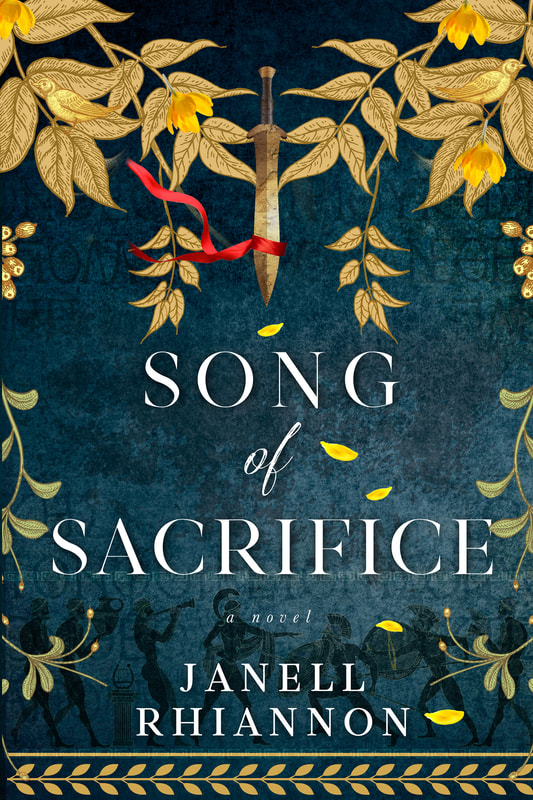
In the Homeric Chronicles series, Song of Sacrifice, she is a regular character who interacts with all her family members. I particularly love her interaction with Clytemnestra.
Click the video above and learn a bit about what (I think) makes Leda tick and hear my favorite scene between her and her eldest daughter. I also have a podcast devoted Hecuba and Leda, as well as Clytemnestra. That's it for today. Be safe everyone.
In the Homeric Chronicles series, Song of Sacrifice, she is a regular character who interacts with all her family members. I particularly love her interaction with Clytemnestra.
Click the video above and learn a bit about what (I think) makes Leda tick and hear my favorite scene between her and her eldest daughter. I also have a podcast devoted Hecuba and Leda, as well as Clytemnestra. That's it for today. Be safe everyone.
Hecuba the Queen of Troy
During the Trojan War, Queen Hecuba of Troy had a decade's long front row seat. Whether from the palace or the city ramparts, she experienced it all. I think one of the most heart-breaking things she had to do was face the fact that in saving one son, she doomed another. Hecuba's life is really a mirror of life in general: the things we seek to change, don't always bring about the intended result. During the Trojan War era, she passes from a "mothering" figure to "crone" (classic archetypes). She's also THE queen. After the city falls, she is awarded to Odysseus as a "prize" of war and her next life begins.
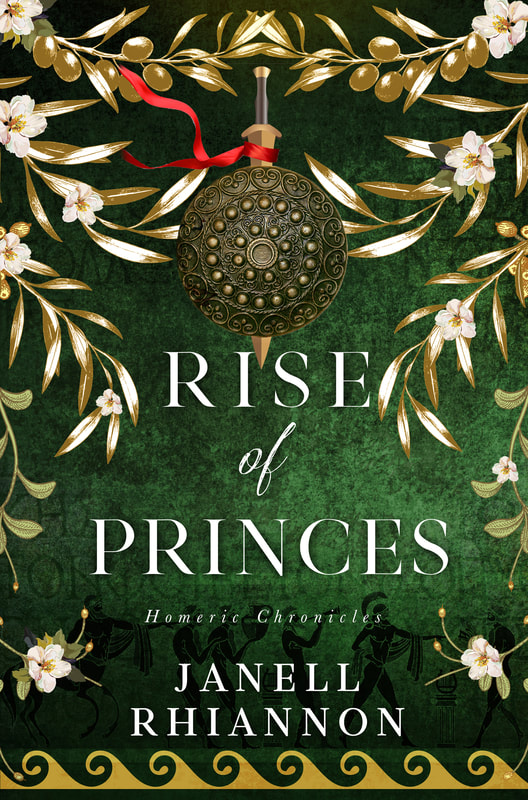
She's a pivotal figure in my Homeric Chronicles series where we fallow her from the birth of Paris through the fall of Troy in Song of Sacrifice, Rise of Princes, and the current book I'm writing called Rage of Queens.
Click on the video and join me in admiring Hecuba.
She's a pivotal figure in my Homeric Chronicles series where we fallow her from the birth of Paris through the fall of Troy in Song of Sacrifice, Rise of Princes, and the current book I'm writing called Rage of Queens.
Click on the video and join me in admiring Hecuba.
Wonder Women of Greek Myth: Hecuba and Leda
Of all the queens in Troy and Greece, Hecuba and Leda hold a special place in my heart. They are the mortal matriarchs of the Trojan War epic. And they deserve their fair share of the limelight along with the likes of Helen, Clytemnestra, Andromache, and even Briseis. I wanted to talk about them side by side, because they share similar qualities as matriarchs of their prestigious families. We can glean quite a bit about our heroes and a mother’s love through their respective narratives. Hecuba and Leda are complex women, having suffered at the hands of the gods and their husbands. They fiercely love their children, almost to a fault. They’re complex and wise, powerful and tender, and uncompromising in their quest to establish control in their worlds.
I’d like to take a wee side road about portraying the feminine role in ancient Greek mythology. I’ve been recently reading a paper by Emily Hauser, PhD and author of the Golden Apple Trilogy, about the ancient women’s voices echoed in modern fiction, and how it’s in the minimal space they’re afforded in the text that gives us the latitude to explore who they were, contemplating their motivations, goals, and achievements in their own right. (Emily Hauser’s paper “There is another story: Writing after the Odyssey in Margaret Atwood’s The Penelopiad” is available at her Academia.edu account.) It got me thinking about how privileged I feel to be writing about all the lovely female characters, which for the most part, hold pivotal positions in the most powerful stories, yet are relegated to being foils or temptations for the male characters, or the objects of illicit desires and subjects of kidnapping and rapes. So, let their voices RISE in modern song.
QUEEN HECUBA is barely mentioned by Homer, yet she undoubtedly played a key parental role in raising Hektor, the greatest defender of Troy. In the tension between Hektor and Achilles, we see a mother’s deep devotion and agony as she’s helpless to keep her grown son safe from the notorious killer, Achilles. For a mother, there’s no such thing as forgetting that your child was once young. You carry them, suckle them, and in return they drank in your presence. Even as a grown man stands before you, rugged and bearded, shoulders wide enough to crush a bull—you can still see the little boy beneath the layers of years. Surely, Hecuba had that kind of bond with her son, Hektor. How might this relationship have evolved? How might she have influenced her son’s maturity and prince hood; his priorities, loyalties, and sense of responsibilities? And most importantly, by looking at Hektor’s story what can we hear Hecuba saying?
We have to go back to the beginning. Hecuba was Priam’s second wife, who became the primary wife and mother to almost 2 dozen royal children. Hektor was likely the first child they had together, as well as the first son with Paris being the second son. Because Hektor was the first born, he probably remembered the baby Paris, who disappeared. Perhaps he knew exactly what happened, maybe not. It doesn’t really matter, only that he was there to witness the effects on his mother. He certainly would’ve remembered his mother’s grief and sadness, because prophesy or not a mother doesn’t forget a child she loses for whatever reason. Because Hecuba’s voice is silenced in the myth, we’ve freedom to explore what she felt by looking at her son’s marriage and her desperate efforts in the Iliad to persuade Hektor not to fight Achilles.
I think Homer (whoever he/she was) understood the implied complexity of Hecuba and Hektor’s relationship on some level. Their marriages are mirrors of each other, and becasue of that we can see and hear a Hecuba more clearly. There’s the implication that Hektor knew the pain his mother carried after the baby was stripped from her arms and afterward, when King Priam took concubines, BECAUSE Homer gave Hektor’s wife, Andromache, a barren womb until the 11th hour. This is a stark contrast to his mother’s fertility and her having to accept the existence of multiple of wives and concubines. No doubt Andromache’s barrenness troubled Hektor for a couple of reasons. First, that he couldn’t father a son, or daughter. Secondly, his only viable option was to take another wife or collect concubines. He of all the princes should’ve had a brood of children to succeed him, if we take Priam’s example into account. So, why didn’t he take a second wife or take a concubine? This is exactly the dynamic I delve into in the Homeric Chronicles, giving us a clearer vision of WHO Hecuba was.
In chapter 7, "A Prince and His Mother" I wrote:
FIVE YEARS, HECUBA thought. Five years and the ache for the son she’d never known still throbbed painfully in her chest. She’d grown accustomed to the hurt. Watching her children romping in the courtyard, the queen sighed. Little Deiphobus entertained his younger twin siblings with his wooden sword and shield. The youngest, Polydorus, nursed at her breast. She’d refused a wet nurse for all of her children after the loss of her second son. Rarely did she allow her children from her sight. The ache for her second son pulled at her again, never giving her peace. In truth, some days she conjured the pain to remind her of his little face, and some days she cursed the sadness and prayed to Apollo and Artemis to wipe her memories of him.
When Hektor appeared at the courtyard gate, she smiled widely despite her melancholy. He waved, making straight for her. Only he had the power to dull the hurt that had become as much a part of her as her hand or foot. The other children, although a source of joy, reminded her of the one she’d lost. Hektor’s presence was the only one not marred by grief. He was her Golden Prince.
Hektor approached and kissed his mother’s cheek. “Mother,” he said, pinching Polydorus’ bare foot. The baby kicked at his eldest brother’s attempted affection. “Such a strong leg for someone so little,” he laughed. “You’re sad again, Mother. I can see it in your eyes.”
Patting his arm with her free hand, she said, “Nothing can be hidden from my Hektor. Someday you’ll be a wise king.” Hecuba sighed, and her eyes found her son’s. “I’ll always be sad. I fear that if I’m not, I’ll forget him forever. And that would be worse. His memory is all your father left me of him.” She switched the baby to her other breast, adjusting his heavy weight in the crook of her arm.
A commotion across the yard drew Hecuba’s attention. “Deiphobus! Be mindful of Helenus! Cassandra, move away from the fountain! Where is Tessa when I need her? Tessa!”
From the balcony above them, Tessa called down to her queen, “Yes, my lady?”
“Come! Take the twins and the baby. They must rest.” Deiphobus laughed at his younger siblings. Hecuba added, “And take Deiphobus, as well.” The boy threw his wooden armaments down, kicking the ground, and mumbled to himself. “Truth be told, I’m the one in need of rest.” She rubbed the side of her swollen belly. “It seems I am forever with child. How was your training?”
Hektor placed his hand on the pommel of his short sword. “I’m much better with the sword than a spear.”
Tessa came to take the children. The queen handed her servant a very sleepy baby. “My lady, he is a fat one.” The nurse cradled him carefully in her arms and steered the gaggle inside, leaving Hektor and his mother alone.
“Where is my father?” Hektor asked.
Hecuba stiffened. “Where he always is this time of day.”
Hektor wrapped his hand around his mother’s, dwarfing hers. “I’ll have only one wife, Mother.”
“We’ll find you a fine wife, Hektor. A beauty in heart, as well as face.”
“If she’s as beautiful as you, I’ll be satisfied. But that is a long way off!” Hektor grinned, warming Hecuba’s heart.
Taking his mother’s hand, he pulled her up. “Come. I want to show you my horse.”
Hecuba stood reluctantly, putting a hand to the small of her back. “The stables are a long walk from here.”
“It’s not so far. Besides, you smile more when away from the palace.”
The stables dominated the entire southwest of the citadel’s lower levels. Spreading out as far as the eye could see, the horse fields were covered in tall, swaying grasses and low brush. From their vantage point, they could see horses running and kicking up clouds of dust. Pausing to admire the horses, Hecuba said, “Can you imagine Troy existing without horses?”
“I wouldn’t recognize our city without them,” Hektor mindlessly answered. “Mother?”
“Yes?”
“I remember him, too,” he said quietly.
Hektor was tall for a boy his age, standing nearly eye to eye with her with his curly black hair shining in the sun. He is the kindest soul. She wrapped her arm around his shoulders, pulling him close to her. “You’re truly Troy’s greatest treasure.”
Hektor looked at his mother, beaming. “You only say that because you’re my mother. What else would you say?”
“I say it because it’s the truth.”
__________
In Troy Fall of a City, they attempt to tackle the effect on Hecuba of abandoning Paris to death. Their Hecuba is at a strange peace with the decision, even though she and Priam have kept the truth from everyone; she doesn’t blame Priam or even the gods really. In fact, Priam is more distraught than she is and it’s Hecuba who comforts Priam all the while, defending the decision. They’re portrayed as an intimate and passionate couple. I find this VOICE and portrayal of Hecuba, unsatisfying. Perhaps, it’s because it’s a masculine writer’s attempt to create a strong Trojan Queen that any true regret and lingering grief was glossed over. Perhaps, a mother tormented all her life by grief somehow made Hecuba seem to the modern masculine writer as weak? Women who’ve lost a child know that in the quiet grief of loss, their deceased children remain alive. The life their child should’ve HAD emerges at each anniversary of death with thoughts like—Today, I would’ve had a 5 year, a 10 year old, or a 15 year old, etc. That’s part of a mother’s strength, carrying and living with this particular pain. And this pain is echoed at any time with a loss of a child at any age. Hecuba’s most passionate and telling scene, as a woman and a mother to Hektor was also incomplete. At the end of the day, TFOAC stripped Hecuba down to a two dimensional character at best.
The fact that Hektor never took a second wife is significant. In the Homeric Chronicles I explore his character as being a lifelong observer of his mother’s grief and heart break. He doesn’t set Andromache aside because he knows firsthand the grief his mother experienced at losing a child, and his mother’s pain at having to watch other women bear her husband’s children. If it was no big deal to have concubines and father children, then he likely would have because the Prince of Troy needed heirs. But we don’t even have whispers this was even in question. Perhaps, he observed his mother growing distant from his father, and didn’t want to risk losing Andromache’s love? Certainly, Hektor loved Andromache, but it was Hecuba, NOT Priam, who taught him HOW to love and honor a woman.
As for Hecuba and Priam’s relationship? Hecuba would surely have been a devoted and dutiful queen to Troy, but I’ve left room for the woman behind the crown. I think it likely she’d blame Priam for the loss of Paris and her years of grief. Watching your husband father a brood of heirs by other women, could certainly create an emotionally distant wife. That’s the path I took anyway in the Homeric Chronicles.
The most telling scene we have of Hecuba is in the end, when Achilles comes for Hektor. Hecuba has already lost several children to the murderous Greek and begs Hektor to stay behind the wall and live. Her agony at anticipating what his death would be, clearly evident. Fagles’ Iliad 22: 94-107 reads:
"And his mother wailed now, standing beside Priam, weeping freely, loosening her robes with one hand and holding out her bare breast with the other, her words pouring forth in a flight of grief and tears: 'Hektor my child! Look—have some respect for this! Pity your mother too, if I ever gave you the breast to soothe you your troubles, remember it now, dear boy—beat back that savage man from safe inside the walls! Don’t go forth, a champion pitted against him—merciless, brutal man. If he kills you now, how can I ever mourn you on your death bed? Dear branch in bloom, dear child I brought to birth!—Neither I nor your wife, that warm, generous women…Now far beyond our reach, now by the Argive ships the rushing dogs will tear you, bolt your flesh!' So they wept, the two of them crying out to their dear son, both pleading time and again but they could not shake the fixed resolve of Hektor.”
What happened to her son was worse than she imagined, one can only wonder how she survived the horrific scene. I think this image of a mother showing her breast is significant to Hecuba’s character. It’s a simple act carrying the most powerful message a woman can give without words. And to make my earlier point more clearly, Hecuba is addressing the mightiest warrior as “child” and “boy” not because she’s diminishing his prowess, but because as a mother her first instinct is to reach the little boy inside the man who she lavished her love and attention on, and who she was able to comfort.
By examining Hektor’s life, we see a Hecuba who is stoic, resilient, and strong. A woman devoted to her children, especially her favorite son, Hektor, almost to a fault. And this bond between mother and son is most evident when, in her desperation to save him from merciless Achilles, she set aside her modesty in front of the court by literally pulling her breast from her gown showing it Hektor, calling him out to ease her agony by reminding him of what she’s given him all his life: love, loyalty, and support.
Let’s turn to the Spartan Queen: LEDA is an intriguing character whose voice, like Hecuba’s, is mostly silent in the text. She’s the Queen of Sparta, wife to Tyndareus, and mother to four famous children: Caster, Pollux, Clytemnestra, and Helen. Yet, most of what we know of her is through her rape by Zeus and her quiet death.
So, I guess the best place to start is with what Zeus did to her. So many works of art and literature have depicted the union of Leda and Zeus as “sensuous” or consensual—but I think it was neither sensual nor consensual. By the balls of Zeus, it was a giant swan. A flapping foul. How can being set upon by an animal, or rain, of a horse not be scary? And the bestiality of it, Zeus or not, is horrifying. By making it “sexy” we diminish the trauma Leda suffered. Furthermore, she’s assaulted not once but twice by my count.
In the first 3 episodes, I debunked the 4 eggs in a batch theory, in favor of a more humanistic approach. There’s no way the brothers, Caster and Pollux, can be the same age as Helen, because they’re grown men when she’s a girl kidnapped for the first time. If you missed episode 1-3 where I talk about my ever-expanding a timeline, you go back and give them a listen. And because I don’t think the brothers were the same age, which means that Leda is assaulted twice by Zeus. Regardless, once would be enough to traumatize Leda, and this would definitely affect her future.
In Song of Princes [Sacrifice], I write the rape of Leda for what it was: awful and horrifying. Zeus used Leda as a tool to dominate and control his world. Clearly, Zeus is a master at manipulating. He doesn’t have to lay with mortal women, yet he seems not to be able to control himself. He’s a serial cheater, who has no respect for Hera, his wife. In a way, Zeus is a mirror of Odysseus’s infidelities, whose cheating we minimize because of his being enchanted by goddesses. Zeus, on the other hand, is the enchanter, the aggressor, the predator. And that’s just not sexy, it’s unbalanced. The power difference between Zeus and his mortal conquests is entirely tipped in his favor, and the women have NO choice but to give him what he wants. That’s what makes his “union” with Leda rape. There’s no equality between Zeus and a woman, only what Zeus wishes to take.
How would this experience affect Leda as a woman, queen, wife and mother? That’s what I thought about as I developed her character. I wanted to reconcile her humanity with the myth. Being raped by Zeus is no doubt a trauma. Leda feels degraded and defiant. It’s that reaction I use to build her into a resilient mythological woman. Leda understands her position in a patriarchal world. She knows she can’t fight Zeus or Tyndareus’ inevitable disdain for her violation. (On Tyndareus’ reaction, I took the Philip of Macedonia route where Philip was disgusted by Olympias after seeing her with Zeus in the form of a snake). She lives with his disgust, but must find her way to create her own world and what measure of control she can. Leda is a complicated, yet easy to understand.
**disclaimer: these are show notes and may note contain everything said in the podcast
I’d like to take a wee side road about portraying the feminine role in ancient Greek mythology. I’ve been recently reading a paper by Emily Hauser, PhD and author of the Golden Apple Trilogy, about the ancient women’s voices echoed in modern fiction, and how it’s in the minimal space they’re afforded in the text that gives us the latitude to explore who they were, contemplating their motivations, goals, and achievements in their own right. (Emily Hauser’s paper “There is another story: Writing after the Odyssey in Margaret Atwood’s The Penelopiad” is available at her Academia.edu account.) It got me thinking about how privileged I feel to be writing about all the lovely female characters, which for the most part, hold pivotal positions in the most powerful stories, yet are relegated to being foils or temptations for the male characters, or the objects of illicit desires and subjects of kidnapping and rapes. So, let their voices RISE in modern song.
QUEEN HECUBA is barely mentioned by Homer, yet she undoubtedly played a key parental role in raising Hektor, the greatest defender of Troy. In the tension between Hektor and Achilles, we see a mother’s deep devotion and agony as she’s helpless to keep her grown son safe from the notorious killer, Achilles. For a mother, there’s no such thing as forgetting that your child was once young. You carry them, suckle them, and in return they drank in your presence. Even as a grown man stands before you, rugged and bearded, shoulders wide enough to crush a bull—you can still see the little boy beneath the layers of years. Surely, Hecuba had that kind of bond with her son, Hektor. How might this relationship have evolved? How might she have influenced her son’s maturity and prince hood; his priorities, loyalties, and sense of responsibilities? And most importantly, by looking at Hektor’s story what can we hear Hecuba saying?
We have to go back to the beginning. Hecuba was Priam’s second wife, who became the primary wife and mother to almost 2 dozen royal children. Hektor was likely the first child they had together, as well as the first son with Paris being the second son. Because Hektor was the first born, he probably remembered the baby Paris, who disappeared. Perhaps he knew exactly what happened, maybe not. It doesn’t really matter, only that he was there to witness the effects on his mother. He certainly would’ve remembered his mother’s grief and sadness, because prophesy or not a mother doesn’t forget a child she loses for whatever reason. Because Hecuba’s voice is silenced in the myth, we’ve freedom to explore what she felt by looking at her son’s marriage and her desperate efforts in the Iliad to persuade Hektor not to fight Achilles.
I think Homer (whoever he/she was) understood the implied complexity of Hecuba and Hektor’s relationship on some level. Their marriages are mirrors of each other, and becasue of that we can see and hear a Hecuba more clearly. There’s the implication that Hektor knew the pain his mother carried after the baby was stripped from her arms and afterward, when King Priam took concubines, BECAUSE Homer gave Hektor’s wife, Andromache, a barren womb until the 11th hour. This is a stark contrast to his mother’s fertility and her having to accept the existence of multiple of wives and concubines. No doubt Andromache’s barrenness troubled Hektor for a couple of reasons. First, that he couldn’t father a son, or daughter. Secondly, his only viable option was to take another wife or collect concubines. He of all the princes should’ve had a brood of children to succeed him, if we take Priam’s example into account. So, why didn’t he take a second wife or take a concubine? This is exactly the dynamic I delve into in the Homeric Chronicles, giving us a clearer vision of WHO Hecuba was.
In chapter 7, "A Prince and His Mother" I wrote:
FIVE YEARS, HECUBA thought. Five years and the ache for the son she’d never known still throbbed painfully in her chest. She’d grown accustomed to the hurt. Watching her children romping in the courtyard, the queen sighed. Little Deiphobus entertained his younger twin siblings with his wooden sword and shield. The youngest, Polydorus, nursed at her breast. She’d refused a wet nurse for all of her children after the loss of her second son. Rarely did she allow her children from her sight. The ache for her second son pulled at her again, never giving her peace. In truth, some days she conjured the pain to remind her of his little face, and some days she cursed the sadness and prayed to Apollo and Artemis to wipe her memories of him.
When Hektor appeared at the courtyard gate, she smiled widely despite her melancholy. He waved, making straight for her. Only he had the power to dull the hurt that had become as much a part of her as her hand or foot. The other children, although a source of joy, reminded her of the one she’d lost. Hektor’s presence was the only one not marred by grief. He was her Golden Prince.
Hektor approached and kissed his mother’s cheek. “Mother,” he said, pinching Polydorus’ bare foot. The baby kicked at his eldest brother’s attempted affection. “Such a strong leg for someone so little,” he laughed. “You’re sad again, Mother. I can see it in your eyes.”
Patting his arm with her free hand, she said, “Nothing can be hidden from my Hektor. Someday you’ll be a wise king.” Hecuba sighed, and her eyes found her son’s. “I’ll always be sad. I fear that if I’m not, I’ll forget him forever. And that would be worse. His memory is all your father left me of him.” She switched the baby to her other breast, adjusting his heavy weight in the crook of her arm.
A commotion across the yard drew Hecuba’s attention. “Deiphobus! Be mindful of Helenus! Cassandra, move away from the fountain! Where is Tessa when I need her? Tessa!”
From the balcony above them, Tessa called down to her queen, “Yes, my lady?”
“Come! Take the twins and the baby. They must rest.” Deiphobus laughed at his younger siblings. Hecuba added, “And take Deiphobus, as well.” The boy threw his wooden armaments down, kicking the ground, and mumbled to himself. “Truth be told, I’m the one in need of rest.” She rubbed the side of her swollen belly. “It seems I am forever with child. How was your training?”
Hektor placed his hand on the pommel of his short sword. “I’m much better with the sword than a spear.”
Tessa came to take the children. The queen handed her servant a very sleepy baby. “My lady, he is a fat one.” The nurse cradled him carefully in her arms and steered the gaggle inside, leaving Hektor and his mother alone.
“Where is my father?” Hektor asked.
Hecuba stiffened. “Where he always is this time of day.”
Hektor wrapped his hand around his mother’s, dwarfing hers. “I’ll have only one wife, Mother.”
“We’ll find you a fine wife, Hektor. A beauty in heart, as well as face.”
“If she’s as beautiful as you, I’ll be satisfied. But that is a long way off!” Hektor grinned, warming Hecuba’s heart.
Taking his mother’s hand, he pulled her up. “Come. I want to show you my horse.”
Hecuba stood reluctantly, putting a hand to the small of her back. “The stables are a long walk from here.”
“It’s not so far. Besides, you smile more when away from the palace.”
The stables dominated the entire southwest of the citadel’s lower levels. Spreading out as far as the eye could see, the horse fields were covered in tall, swaying grasses and low brush. From their vantage point, they could see horses running and kicking up clouds of dust. Pausing to admire the horses, Hecuba said, “Can you imagine Troy existing without horses?”
“I wouldn’t recognize our city without them,” Hektor mindlessly answered. “Mother?”
“Yes?”
“I remember him, too,” he said quietly.
Hektor was tall for a boy his age, standing nearly eye to eye with her with his curly black hair shining in the sun. He is the kindest soul. She wrapped her arm around his shoulders, pulling him close to her. “You’re truly Troy’s greatest treasure.”
Hektor looked at his mother, beaming. “You only say that because you’re my mother. What else would you say?”
“I say it because it’s the truth.”
__________
In Troy Fall of a City, they attempt to tackle the effect on Hecuba of abandoning Paris to death. Their Hecuba is at a strange peace with the decision, even though she and Priam have kept the truth from everyone; she doesn’t blame Priam or even the gods really. In fact, Priam is more distraught than she is and it’s Hecuba who comforts Priam all the while, defending the decision. They’re portrayed as an intimate and passionate couple. I find this VOICE and portrayal of Hecuba, unsatisfying. Perhaps, it’s because it’s a masculine writer’s attempt to create a strong Trojan Queen that any true regret and lingering grief was glossed over. Perhaps, a mother tormented all her life by grief somehow made Hecuba seem to the modern masculine writer as weak? Women who’ve lost a child know that in the quiet grief of loss, their deceased children remain alive. The life their child should’ve HAD emerges at each anniversary of death with thoughts like—Today, I would’ve had a 5 year, a 10 year old, or a 15 year old, etc. That’s part of a mother’s strength, carrying and living with this particular pain. And this pain is echoed at any time with a loss of a child at any age. Hecuba’s most passionate and telling scene, as a woman and a mother to Hektor was also incomplete. At the end of the day, TFOAC stripped Hecuba down to a two dimensional character at best.
The fact that Hektor never took a second wife is significant. In the Homeric Chronicles I explore his character as being a lifelong observer of his mother’s grief and heart break. He doesn’t set Andromache aside because he knows firsthand the grief his mother experienced at losing a child, and his mother’s pain at having to watch other women bear her husband’s children. If it was no big deal to have concubines and father children, then he likely would have because the Prince of Troy needed heirs. But we don’t even have whispers this was even in question. Perhaps, he observed his mother growing distant from his father, and didn’t want to risk losing Andromache’s love? Certainly, Hektor loved Andromache, but it was Hecuba, NOT Priam, who taught him HOW to love and honor a woman.
As for Hecuba and Priam’s relationship? Hecuba would surely have been a devoted and dutiful queen to Troy, but I’ve left room for the woman behind the crown. I think it likely she’d blame Priam for the loss of Paris and her years of grief. Watching your husband father a brood of heirs by other women, could certainly create an emotionally distant wife. That’s the path I took anyway in the Homeric Chronicles.
The most telling scene we have of Hecuba is in the end, when Achilles comes for Hektor. Hecuba has already lost several children to the murderous Greek and begs Hektor to stay behind the wall and live. Her agony at anticipating what his death would be, clearly evident. Fagles’ Iliad 22: 94-107 reads:
"And his mother wailed now, standing beside Priam, weeping freely, loosening her robes with one hand and holding out her bare breast with the other, her words pouring forth in a flight of grief and tears: 'Hektor my child! Look—have some respect for this! Pity your mother too, if I ever gave you the breast to soothe you your troubles, remember it now, dear boy—beat back that savage man from safe inside the walls! Don’t go forth, a champion pitted against him—merciless, brutal man. If he kills you now, how can I ever mourn you on your death bed? Dear branch in bloom, dear child I brought to birth!—Neither I nor your wife, that warm, generous women…Now far beyond our reach, now by the Argive ships the rushing dogs will tear you, bolt your flesh!' So they wept, the two of them crying out to their dear son, both pleading time and again but they could not shake the fixed resolve of Hektor.”
What happened to her son was worse than she imagined, one can only wonder how she survived the horrific scene. I think this image of a mother showing her breast is significant to Hecuba’s character. It’s a simple act carrying the most powerful message a woman can give without words. And to make my earlier point more clearly, Hecuba is addressing the mightiest warrior as “child” and “boy” not because she’s diminishing his prowess, but because as a mother her first instinct is to reach the little boy inside the man who she lavished her love and attention on, and who she was able to comfort.
By examining Hektor’s life, we see a Hecuba who is stoic, resilient, and strong. A woman devoted to her children, especially her favorite son, Hektor, almost to a fault. And this bond between mother and son is most evident when, in her desperation to save him from merciless Achilles, she set aside her modesty in front of the court by literally pulling her breast from her gown showing it Hektor, calling him out to ease her agony by reminding him of what she’s given him all his life: love, loyalty, and support.
Let’s turn to the Spartan Queen: LEDA is an intriguing character whose voice, like Hecuba’s, is mostly silent in the text. She’s the Queen of Sparta, wife to Tyndareus, and mother to four famous children: Caster, Pollux, Clytemnestra, and Helen. Yet, most of what we know of her is through her rape by Zeus and her quiet death.
So, I guess the best place to start is with what Zeus did to her. So many works of art and literature have depicted the union of Leda and Zeus as “sensuous” or consensual—but I think it was neither sensual nor consensual. By the balls of Zeus, it was a giant swan. A flapping foul. How can being set upon by an animal, or rain, of a horse not be scary? And the bestiality of it, Zeus or not, is horrifying. By making it “sexy” we diminish the trauma Leda suffered. Furthermore, she’s assaulted not once but twice by my count.
In the first 3 episodes, I debunked the 4 eggs in a batch theory, in favor of a more humanistic approach. There’s no way the brothers, Caster and Pollux, can be the same age as Helen, because they’re grown men when she’s a girl kidnapped for the first time. If you missed episode 1-3 where I talk about my ever-expanding a timeline, you go back and give them a listen. And because I don’t think the brothers were the same age, which means that Leda is assaulted twice by Zeus. Regardless, once would be enough to traumatize Leda, and this would definitely affect her future.
In Song of Princes [Sacrifice], I write the rape of Leda for what it was: awful and horrifying. Zeus used Leda as a tool to dominate and control his world. Clearly, Zeus is a master at manipulating. He doesn’t have to lay with mortal women, yet he seems not to be able to control himself. He’s a serial cheater, who has no respect for Hera, his wife. In a way, Zeus is a mirror of Odysseus’s infidelities, whose cheating we minimize because of his being enchanted by goddesses. Zeus, on the other hand, is the enchanter, the aggressor, the predator. And that’s just not sexy, it’s unbalanced. The power difference between Zeus and his mortal conquests is entirely tipped in his favor, and the women have NO choice but to give him what he wants. That’s what makes his “union” with Leda rape. There’s no equality between Zeus and a woman, only what Zeus wishes to take.
How would this experience affect Leda as a woman, queen, wife and mother? That’s what I thought about as I developed her character. I wanted to reconcile her humanity with the myth. Being raped by Zeus is no doubt a trauma. Leda feels degraded and defiant. It’s that reaction I use to build her into a resilient mythological woman. Leda understands her position in a patriarchal world. She knows she can’t fight Zeus or Tyndareus’ inevitable disdain for her violation. (On Tyndareus’ reaction, I took the Philip of Macedonia route where Philip was disgusted by Olympias after seeing her with Zeus in the form of a snake). She lives with his disgust, but must find her way to create her own world and what measure of control she can. Leda is a complicated, yet easy to understand.
**disclaimer: these are show notes and may note contain everything said in the podcast
Discover more about Queen Hecuba and Queen Leda in the Homeric Chronicles.
TROY
ONE, smoke and dreams
1290 BCE
“There now, you’re safe,” Hecuba whispered, standing in a pool of silver moonlight. A cool breeze fluttered the privacy draping surrounding the royal balcony. Heavy with child, she craved the cool night air on her face and against her damp skin. “If I should lose you, my heart …” The baby kicked at her protective hands.
Reaching for the polished stone railing, she leaned into the night. Hecuba scanned the entire skyline of the Trojan citadel, reaching far into the blackness of the night. Throughout the city, the orange glow of oil lamps broke through the black night, dotting windows of merchant shops and citizens, reassuring her that Troy was at peace. The child stretched as the pull of the Moon Goddess stirred her unborn child. She closed her eyes to the city. By all the gods, I beg you, let this child live.
When Hektor came to the light, she rejoiced in his black curls and hazy blue eyes. She’d kissed each finger and each toe. It was the only time she’d ever seen her husband weep. Hektor was the Golden Prince of Troy. The beloved son. She quickly conceived again, but the joyous birth ended in mourning. And then again with the third. Hecuba, grief stricken and desperate, routinely made sacrifices to Apollo and Artemis. She’d even set up a private shrine to Eleithyia, Goddess of Childbirth, in her private quarters. But not until now had her womb quickened for a fourth time with the king’s seed.
Hecuba rubbed her naked belly again, and ran her hands up to cup each aching breast. Beneath the inky blue sky dusted with stars, she prayed. Please. What must I do?
Only recently had she even dared to believe that this child would come to the light as another proud young prince or princess for Troy. But as soon as she embraced the thin hope of happiness, the gods sent her a troubling vision. The jumbled images held no clear meaning, but try as she might, she couldn’t dismiss them. The figure of the foreign warrior, armored all in gold, haunted her even in the light of Apollo. “There can be no promises between lions and men.”
A light caught in the corner of her eye and she turned to see the dark outline of her husband’s body as he slid from their bed, holding a small oil lamp in his hand.
“What is it, Hecuba?” King Priam’s voice, rough with sleep soothed her from across the room. The king came up behind her, pressing his warm, naked skin against her nude backside. He set the lamp on the balcony railing.
Hecuba shrugged. “It’s nothing, my love. The child is restless.”
Reaching for her himation draped over a sitting bench, he wrapped the finely spun cloth around her shoulders. “You and our son will catch a chill.” Priam’s hands slid down the familiar curves of his wife’s widening waist, then up to the sides of her heavy breasts. His lips brushed against the nape of her neck, his warm breath raising the fine hairs along her arms. “You’re too tempting without a covering.”
She took his hands in hers, placing them on the widest part of her belly. “Surely, one of your concubines would please you more than I. What if it is a daughter?”
King Priam chuckled. “I love all our children.” He gently nipped Hecuba’s neck with his teeth. “You know there is no one I desire more than you.”
She swatted at his exploring hands. “Leave me be.”
He gently pinched her nipples, until they wrinkled into tight buds. “We’re no strangers to these discomforts are we, my love?”
Hecuba reluctantly accepted the tradition that as Queen of Troy, she’d never be the only woman in her husband’s life. After the loss of two heirs, the king’s councilors urged Priam to take other wives and concubines. Custom, after all, decreed that the King of Troy should have as many children as possible, securing the royal line and breeding strong, valiant Trojan commanders and warriors. When Priam had agreed, Hecuba realized for the first time what it meant to truly be queen. The king would be her whole world, but he’d enjoy a life separate from the one he shared with her.
In these moments of weakness and self-doubt, she reminded herself that he’d chosen her for love, not simply duty or lust. He proved his loyalty to her by sharing the royal bed only with her, his queen, every night without fail. No concubines or other wives desecrated their private chambers. Priam had never remained long in the arms of another woman after mating, always returning to her freshly bathed. She’d never caught the lingering scent of another woman on her husband’s skin or dress. But, from time to time, she’d catch sight of a beautiful woman with a rounded belly. And soon, little children with dark curls and dimpled chins ran about the halls and courtyard. Hecuba knew in her heart they belonged to Priam, but she could never voice her agony or speak of betrayal. The king would do what he must for the city.
“Why are you standing here, naked for all of Troy to see?”
“I couldn’t sleep.”
Priam sighed. “Is it the vision?”
Hecuba nodded. “I can’t forget it.” She pulled his arms tighter around her. “It frightened me,” she admitted. “I hear that warrior’s voice roaring in my head. No promises between lions and men. What does it mean? We’re at peace, finally. Aren’t we?”
“War is inevitable, Hecuba. I know why you’re fearful.”
“What if—“
“It means nothing, sweet wife.”
She shivered in his arms. “But the warrior—“
He leaned his cheek against hers. “Consult Iphicrates in the morning, if it will ease your mind. Now, come to bed, wife. I grow cold.”
Hecuba turned in his arms, catching the mischievous gleam in his eye. “You will keep me with child until I am old and grey.”
Priam stung her buttocks with a firm slap. “That would not be such a bad thing.” He swooped up his pregnant wife, protesting and laughing, and carried her to their bed. The himation slipped to the floor. Despite her growing belly, she wrapped her legs around his still narrow waist. He growled into her neck, biting and kissing her.
Hecuba nipped the square of his chin, and then grabbed his curly black hair at the nape of his neck, pulling his head closer so her teeth could find his earlobe. She kissed softly down his neck.
Untangling her legs from his waist, he positioned her against the pillows. “You’re a playful woman,” he laughed. “And you’ll pay for teasing your king with such kisses.”
Hecuba cocked an eyebrow. “How shall I pay you? I have no gold or silver, my lord.”
The king knelt between her legs; his eyes burned with passion. “You have buried your treasure and …” Priam bent down, ***EDIT sex scene*** (Sorry, it was a good one, too)***
Hecuba wrapped her legs around his thighs, digging her heels into his upper thighs. “Priam, by Apollo … now.”
When her pleasured moans echoed across the chamber, Priam roared his release over hers. They collapsed together, their legs tangled in the bed linen. With a contented sigh, Priam collapsed on his side and fell back into an easy sleep.
Hecuba stared into the dark for a long while, until sheer exhaustion pulled her into the restless world of nightmares.
__________________________________________
APOLLO’S LIGHT, FLASHING off the golden helm and shield of the foreigner, blinded Hecuba as she gazed down from the dizzy heights of Troy’s southern wall. The stranger caught her stare, his eyes flashing blue fire, chilling her to the bone. She pulled her dark veil tighter around her face. The warrior hefted a bronze-tipped spear, leveling it at the man armored as a Trojan warrior. His helm hides his face. But I know him … how do I know him? It’s not Priam. But who?
From below, the foreigner’s voice thundered through the air, shaking the stone foundation beneath her feet. “There can be no promises between lions and men!”
Hecuba watched in horror as the golden armored man charged with shield tilted and spear leveled for a fatal strike. We are not at war? How can this be? The men crashed into one another, splintering their shields, tossing the remnants to the ground. With a roar, the tall, golden warrior circled and attacked like a lion. Death sang clearly in the clash of their silver swords. The queen’s heart pounded frantically, knowing one of them would surely die.
The queen opened her mouth to scream the burning questions: Who are you? Why do you fight? But, the words dusted on her tongue. She clasped her hands beneath her heavy belly. Not now. Not now. Dust swirled about the combatant’s feet, as they danced to their death. The shining warrior lunged with grace, his spear finding the soft flesh beneath the Trojan warrior’s shoulder. The foreigner laughed as the spray of blood splattered across his armor. The man whose face remained in shadow dropped hard to his knees, his chin bobbing close to his chest. Is he dead? Who are you? Why are you here? In that moment; Hecuba realized she stood alone on the rampart. Where is Priam? She turned to see smoke rising from the citadel. What is happening? Priam! Priam! Where have you gone? Why have you left me alone?
Warm liquid trickled down her inner thighs. Hecuba glanced down to see a pool of blood at her feet. Her fingertips bled as she gripped the edge of the stone wall, bracing for the birth. I cannot have the child on the wall. A searing pain tore through her, dropping her to all fours. Not yet. Not yet. She placed a trembling hand to her sacred opening, feeling for the baby. Her fingers touched a rounded object emerging. Screaming, she pushed for relief. In triumph, she pulled it forth, only to find she held not her long-awaited son, but a burning log. She dropped it, screaming and running from the wall.
__________________________________________
“MAMA? MAMA, WAKE up now.” Little Hektor peered over the edge of his mother’s bed, placing his chubby hand on her arm. “Mama?”
Hecuba opened her eyes to see her eldest child. Hektor was a glorious boy. His eyes shone like two polished stones of lapis lazuli, a gift from the gods. The rest of him exuded Priam’s stock—the black curls framing a handsome face, the slight dip in the middle of his tiny chin, and the bump of Priam’s strong nose. Hecuba loved her son’s contagious lopsided smile the most. Whenever Hektor asked his father why they both shared the same chin, Priam regaled him with the story of how Zeus touched the chin of all those of royal Trojan blood. “It is a mark of honor,” he would say. “A mark of the princes and kings of Troy.”
The queen gently placed her hand over her son’s. “I am awake now, Hektor. Tell me, what have you been doing all morning?”
Hektor’s eyes rounded with excitement. “I was in the stables with Xenos,” he took a big breath, “helping with the horses.”
“As a Trojan prince should. What else did you do?”
Hektor’s face beamed. “I rode Ares for the first time.” The young prince loved his horse. Priam had purchased the stallion as a colt from the southern Troad where the finest war horses were bred. The colt’s sleek obsidian coat and the luminous white crescent stamped on its forehead set him apart from all the others in the royal stable. Hektor and Ares had become inseparable. Life existed this way for the princes of Troy. The Trojan tradition of breaking horses was a gift admired far and wide, reaching even across the storming seas. Some worlds revered their fast ships and others their monuments stretching toward the heavens, but the Trojans venerated their magnificent horses. A warrior’s worth extended to the mount he rode into battle, honor and nobility bonding the rider and the steed. And for a chosen few, the god Apollo gifted the ability of communicating directly with the majestic beasts by whispering secret words into their ears. The gift had not come to Hektor, but Hecuba hoped it might be granted to the son she now carried.
“And how is Mighty Ares?”
“He grows strong, Mama. He ate all of the oats I carried to him.”
Queen Hecuba sat up, pulling the boy to her side. “Did you ride long, then, this morning?”
“Yes.” Hektor’s gaze fell to his hands. “But I fell off.”
Hecuba tilted her son’s chin up. “Xenos tells me all warriors fall off. Even princes and sometimes, even kings.” She tapped his nose. “With my own eyes I have seen your father tossed more times than I have fingers.” She held up both hands showing all ten fingers, wiggling each one for emphasis.
Hektor squinted in disbelief at his mother. “My father fell off that many times?”
“Yes,” the queen laughed. “Breaking horses is difficult when you do not grow up together as you and Mighty Ares have. Some horses never feel the weight of a man until they are already grown. They are wild, free spirited beasts.”
Hektor shrugged his little shoulders. “Someday, I will break the horses.”
“Yes, I am certain you will.”
Hektor’s eyes sparkled with the anticipation only an innocent could have. “And learn to fight.” He spoke of war as a game he’d play, running safety back to his mother’s arms.
Icy fingers squeezed the queen’s heart. Her dream of the foreign warrior, lunging gracefully with a spear poised for a lethal strike loomed behind her eyes. His voice thundering, ”There can be no promises between lions and men.” Hecuba willed the image to a shadow with a shake of her head. She recalled what Priam had said about war being inevitable. Was it a god-sign? A warning? A mother’s fear? Looking at her little boy, her heart ached. She wanted her husband to be wrong, to believe that war was an invention of greed that diplomacy and honor could wipe from their world.
The moment passed as quickly as it had overwhelmed her. It’s a woman’s burden knowing men will one day go to war. Since girlhood, she’d been raised knowing this was the way of life, but now, as a mother, she agonized over it. Men wished to be proud warriors, heeding the call to battle, holding their shields and spears aloft, and roaring their blood lust for battle to Ares as they charged headlong into the face of possible death. Fathers raised sons, and those sons raised more sons … all glorifying the field of battle and the dark God of War, Ares, for honor and song.
All women, even queens, faced the agonies of war’s aftermath. Bodies broken beyond recognition, bloody wounds requiring a steady hand to stitch them closed, and ruined minds to mend. All that paling in comparison to washing and dressing the dead for the funeral pyres, and when the smell of burning flesh filled the air, men swore under their breath it would be the last. Until the next season brought new challenges, and it all began again.
Hecuba pulled Hektor’s little head toward hers and kissed him on top of his curls. He smelled of hay. “You will be a great warrior someday, my little Hektor, breaker of horses, my golden prince.”
Hektor wrinkled his nose at his mother and crossed his slender arms across his chest. “I’m not little.”
Hecuba pinched his cheek. “Only to me, sweet boy.” Hektor leapt into his mother’s bed. She tickled him under his arms. Rounds of cheerful giggles bounced across the chamber, echoing out the open windows. Hecuba forced all of the frightening prospects of the future from her mind. She poured her affection and joy into the moment with her son laughing next to her.
He put his hand on his mother’s rounded belly. “Is he truly inside of you?”
“Yes, he is,” Hecuba said. “But, don’t be disappointed if it’s a girl. Kings need daughters, too.”
Hektor laughed. “I can’t break horses with a sister. I see a brother for me. We will ride together. Fight together.”
Hecuba’s eyes filled with tears. “Then, a boy it must be.”
__________________________________________
HECUBA’S VISION DISTURBED Priam more than he allowed her to believe, stealing his peace with each passing day. When the priests summoned him, he traveled alone cloaked through the city he loved, the stone streets winding toward the citadel’s center where Apollo’s temple stood. The city’s inhabitants regaled their patron god’s part in building their fortress home in songs, holding many festivals in his honor.
Apollo’s temple dazzled with marble pillars towering to dizzying heights set against the expanse of the heavens. Paintings of gods and goddesses and their heroic deeds spiraled every marble column from cap to base around the outer perimeter of the temple. On each corner, a magnificent sculpture of Apollo held up the temple’s roof with the structure resting on each statue’s shoulders. A carved relief depicting Apollo and Poseidon building Troy’s great ramparts adorned the immense pediment above the temple’s entrance and black marble paved the entry.
As Priam passed beneath the great triangle, entering Apollo’s sacred space, he thought of his legacy, his immortality. For him, it lay in the hope that his sons and grandsons depicted his life in some glorious measure on a wall or column or in a song of his great deeds. Trojan kings may rule the city, but in the end it was the city itself that was the true inheritance of all Trojan kings. He must protect it.
The king walked to the cella, the sacred chamber, readying his offering on the plinth stone. Setting down the small basket of pearls and the shimmering gold crown of laurel leaves, he wondered if it was enough. In the morning, I will bring a fatted bull as well.
An errant pearl slipped through the basket, bouncing behind the wall of blue curtains where Apollo’s secrets floated as whispers into the ears of eager priests and priestesses. Sheer blue fabric shielded the sacred adyton from the direct gaze of supplicants, preserving the sanctity and the mystery of the god. Priam heard the pearl roll to silence. I have not brought nearly enough. I cannot carry the entire treasury on my back. Why was I summoned? Was it Hecuba’s vision?
A priestess with hair as pale as summer honey emerged holding the lost pearl in her palm. Her dark grey eyes looked on him with pity, as she placed the gem in his outstretched hand.
Priam placed it back with the others. “Gratitude.”
When her steady gaze probed his face, the black ice of her pupils pierced through all of his fears. “You are troubled, King Priam.”
“It is not every day one is summoned to the god.”
The priestess nodded. “That is true.”
“Why am I here?”
“Apollo demands a great sacrifice. Troy must be saved.”
King Priam shook his head in confusion. “But we are not at war?”
“The city will fall before a descendant of Aeacus, unless the boy dies.”
“Troy has no quarrel with the western tribes. Pirating along the southern Troad coast has died down to nothing. We bear the west no ill will,” Priam argued. Then … “What boy?”
“Your unborn son.”
Priam’s knees buckled and he caught himself on the altar’s edge. “It is a boy?”
“He is.”
The king’s mind reeled. “I cannot kill my own child. My son.” How could I do such a thing? How would I tell Hecuba?
“Then, Troy will perish.”
“Why does Apollo punish me with this task? Have I not made all of the offerings? Does Troy not venerate the Shining One above all others?”
The priestess folded her hands. “Do you remember your sister, Priam?”
Guilt surged through Priam’s heart. “I lost my entire family the day Hesione was taken from Troy. How could I forget?” The image of Hesione’s pale blue gown fluttering in the wind, her head bowed low, as Herakles dragged her off to his ship still haunted him all these years later. “Priestess, Apollo must know what happened to Hesione was not my fault. My father—”
“Your father’s legacy is yours as well. A royal daughter of Troy now lives among the Greeks. What was it, Priam? Cowardice or greed?”
Priam clenched his jaw, his face flushed with frustration. “I had been away. I am not responsible for my father’s dishonor. What else could I do in that moment?”
“What could you have done? That is what Apollo wishes to know. Gods test mortals in many ways. And you doubted Apollo.”
Priam’s face shook, the vein on his forehead bulged. “Where was Apollo when Herakles and his Greeks came to Troy? What happened was not because of me.”
The priestess remained unmoved. “Unless you obey him, Troy will be burnt to ashes, wiped clean from mortal memory. The wall will crumble to ruin and dust. The sand will drink the blood of Trojan warriors. And its women and children condemned to slavery. Is refusing this sacrifice worth the lives of thousands upon thousands?”
Priam’s hope of saving his unborn son slipped from his fingers. “Is there no other way, Priestess? I beg Apollo to take my life in his place. Just let my son live.”
“If he lives, Troy will burn. It’s that simple. There can be no oaths between lions and men.” She disappeared behind the blue veil.
Suddenly, it struck him. He’d heard that warning before in Hecuba’s vision. “Wait! What does that mean? About lions and men?” But the priestess was gone and he dared not follow her.
Priam’s heart sank, knowing Apollo refused a compromise. As the king, there would be only one choice, and as a father it was no choice at all. Priam understood, now, his complicity in the episode looming before his family and city. I was a coward. And deeper yet, he knew he craved the power of kings. I have brought this on myself. Hecuba … she’ll never forgive me. Perhaps he would yet find a way around this. Maybe Apollo tests me again? Maybe he will stay my hand in the final moment? There was time to win Apollo’s favor.
__________________________________________
“WHAT NEWS FROM Apollo’s priests?” Hecuba could stand the silence between them no longer. “We keep no secrets between us.”
Priam stared into the hearth fire.
Hecuba could see the flames reflecting in his stony dark eyes. “Priam?”
“They say the babe must die, or Troy will fall.”
The words pierced Hecuba’s heart, stealing her breath away. Tears burned at the edges of her eyes. “Surely, you don’t intend to listen.”
Priam turned his wounded eyes to his wife. “I don’t know what I intend. If Apollo does not relent, I must choose between one life and thousands.”
“But it’s our child.”
Priam’s nostrils flared and his chin shook. “Do you think I am unaware of that? That I haven’t grieved in my heart for our lost children? Do you think I want this?”
Placing her hands on her rounded middle, Hecuba choked down her tears. “I beg you, make more sacrifices. Whatever Apollo wants, give it to him.”
Priam took a long drink of his wine. “He asks only for our son, nothing less.”
“Is there … no hope?” Tears fell from her eyes like summer rain.
“Hope.” He drained his cup. “That’s all we have left to us.”
ONE, smoke and dreams
1290 BCE
“There now, you’re safe,” Hecuba whispered, standing in a pool of silver moonlight. A cool breeze fluttered the privacy draping surrounding the royal balcony. Heavy with child, she craved the cool night air on her face and against her damp skin. “If I should lose you, my heart …” The baby kicked at her protective hands.
Reaching for the polished stone railing, she leaned into the night. Hecuba scanned the entire skyline of the Trojan citadel, reaching far into the blackness of the night. Throughout the city, the orange glow of oil lamps broke through the black night, dotting windows of merchant shops and citizens, reassuring her that Troy was at peace. The child stretched as the pull of the Moon Goddess stirred her unborn child. She closed her eyes to the city. By all the gods, I beg you, let this child live.
When Hektor came to the light, she rejoiced in his black curls and hazy blue eyes. She’d kissed each finger and each toe. It was the only time she’d ever seen her husband weep. Hektor was the Golden Prince of Troy. The beloved son. She quickly conceived again, but the joyous birth ended in mourning. And then again with the third. Hecuba, grief stricken and desperate, routinely made sacrifices to Apollo and Artemis. She’d even set up a private shrine to Eleithyia, Goddess of Childbirth, in her private quarters. But not until now had her womb quickened for a fourth time with the king’s seed.
Hecuba rubbed her naked belly again, and ran her hands up to cup each aching breast. Beneath the inky blue sky dusted with stars, she prayed. Please. What must I do?
Only recently had she even dared to believe that this child would come to the light as another proud young prince or princess for Troy. But as soon as she embraced the thin hope of happiness, the gods sent her a troubling vision. The jumbled images held no clear meaning, but try as she might, she couldn’t dismiss them. The figure of the foreign warrior, armored all in gold, haunted her even in the light of Apollo. “There can be no promises between lions and men.”
A light caught in the corner of her eye and she turned to see the dark outline of her husband’s body as he slid from their bed, holding a small oil lamp in his hand.
“What is it, Hecuba?” King Priam’s voice, rough with sleep soothed her from across the room. The king came up behind her, pressing his warm, naked skin against her nude backside. He set the lamp on the balcony railing.
Hecuba shrugged. “It’s nothing, my love. The child is restless.”
Reaching for her himation draped over a sitting bench, he wrapped the finely spun cloth around her shoulders. “You and our son will catch a chill.” Priam’s hands slid down the familiar curves of his wife’s widening waist, then up to the sides of her heavy breasts. His lips brushed against the nape of her neck, his warm breath raising the fine hairs along her arms. “You’re too tempting without a covering.”
She took his hands in hers, placing them on the widest part of her belly. “Surely, one of your concubines would please you more than I. What if it is a daughter?”
King Priam chuckled. “I love all our children.” He gently nipped Hecuba’s neck with his teeth. “You know there is no one I desire more than you.”
She swatted at his exploring hands. “Leave me be.”
He gently pinched her nipples, until they wrinkled into tight buds. “We’re no strangers to these discomforts are we, my love?”
Hecuba reluctantly accepted the tradition that as Queen of Troy, she’d never be the only woman in her husband’s life. After the loss of two heirs, the king’s councilors urged Priam to take other wives and concubines. Custom, after all, decreed that the King of Troy should have as many children as possible, securing the royal line and breeding strong, valiant Trojan commanders and warriors. When Priam had agreed, Hecuba realized for the first time what it meant to truly be queen. The king would be her whole world, but he’d enjoy a life separate from the one he shared with her.
In these moments of weakness and self-doubt, she reminded herself that he’d chosen her for love, not simply duty or lust. He proved his loyalty to her by sharing the royal bed only with her, his queen, every night without fail. No concubines or other wives desecrated their private chambers. Priam had never remained long in the arms of another woman after mating, always returning to her freshly bathed. She’d never caught the lingering scent of another woman on her husband’s skin or dress. But, from time to time, she’d catch sight of a beautiful woman with a rounded belly. And soon, little children with dark curls and dimpled chins ran about the halls and courtyard. Hecuba knew in her heart they belonged to Priam, but she could never voice her agony or speak of betrayal. The king would do what he must for the city.
“Why are you standing here, naked for all of Troy to see?”
“I couldn’t sleep.”
Priam sighed. “Is it the vision?”
Hecuba nodded. “I can’t forget it.” She pulled his arms tighter around her. “It frightened me,” she admitted. “I hear that warrior’s voice roaring in my head. No promises between lions and men. What does it mean? We’re at peace, finally. Aren’t we?”
“War is inevitable, Hecuba. I know why you’re fearful.”
“What if—“
“It means nothing, sweet wife.”
She shivered in his arms. “But the warrior—“
He leaned his cheek against hers. “Consult Iphicrates in the morning, if it will ease your mind. Now, come to bed, wife. I grow cold.”
Hecuba turned in his arms, catching the mischievous gleam in his eye. “You will keep me with child until I am old and grey.”
Priam stung her buttocks with a firm slap. “That would not be such a bad thing.” He swooped up his pregnant wife, protesting and laughing, and carried her to their bed. The himation slipped to the floor. Despite her growing belly, she wrapped her legs around his still narrow waist. He growled into her neck, biting and kissing her.
Hecuba nipped the square of his chin, and then grabbed his curly black hair at the nape of his neck, pulling his head closer so her teeth could find his earlobe. She kissed softly down his neck.
Untangling her legs from his waist, he positioned her against the pillows. “You’re a playful woman,” he laughed. “And you’ll pay for teasing your king with such kisses.”
Hecuba cocked an eyebrow. “How shall I pay you? I have no gold or silver, my lord.”
The king knelt between her legs; his eyes burned with passion. “You have buried your treasure and …” Priam bent down, ***EDIT sex scene*** (Sorry, it was a good one, too)***
Hecuba wrapped her legs around his thighs, digging her heels into his upper thighs. “Priam, by Apollo … now.”
When her pleasured moans echoed across the chamber, Priam roared his release over hers. They collapsed together, their legs tangled in the bed linen. With a contented sigh, Priam collapsed on his side and fell back into an easy sleep.
Hecuba stared into the dark for a long while, until sheer exhaustion pulled her into the restless world of nightmares.
__________________________________________
APOLLO’S LIGHT, FLASHING off the golden helm and shield of the foreigner, blinded Hecuba as she gazed down from the dizzy heights of Troy’s southern wall. The stranger caught her stare, his eyes flashing blue fire, chilling her to the bone. She pulled her dark veil tighter around her face. The warrior hefted a bronze-tipped spear, leveling it at the man armored as a Trojan warrior. His helm hides his face. But I know him … how do I know him? It’s not Priam. But who?
From below, the foreigner’s voice thundered through the air, shaking the stone foundation beneath her feet. “There can be no promises between lions and men!”
Hecuba watched in horror as the golden armored man charged with shield tilted and spear leveled for a fatal strike. We are not at war? How can this be? The men crashed into one another, splintering their shields, tossing the remnants to the ground. With a roar, the tall, golden warrior circled and attacked like a lion. Death sang clearly in the clash of their silver swords. The queen’s heart pounded frantically, knowing one of them would surely die.
The queen opened her mouth to scream the burning questions: Who are you? Why do you fight? But, the words dusted on her tongue. She clasped her hands beneath her heavy belly. Not now. Not now. Dust swirled about the combatant’s feet, as they danced to their death. The shining warrior lunged with grace, his spear finding the soft flesh beneath the Trojan warrior’s shoulder. The foreigner laughed as the spray of blood splattered across his armor. The man whose face remained in shadow dropped hard to his knees, his chin bobbing close to his chest. Is he dead? Who are you? Why are you here? In that moment; Hecuba realized she stood alone on the rampart. Where is Priam? She turned to see smoke rising from the citadel. What is happening? Priam! Priam! Where have you gone? Why have you left me alone?
Warm liquid trickled down her inner thighs. Hecuba glanced down to see a pool of blood at her feet. Her fingertips bled as she gripped the edge of the stone wall, bracing for the birth. I cannot have the child on the wall. A searing pain tore through her, dropping her to all fours. Not yet. Not yet. She placed a trembling hand to her sacred opening, feeling for the baby. Her fingers touched a rounded object emerging. Screaming, she pushed for relief. In triumph, she pulled it forth, only to find she held not her long-awaited son, but a burning log. She dropped it, screaming and running from the wall.
__________________________________________
“MAMA? MAMA, WAKE up now.” Little Hektor peered over the edge of his mother’s bed, placing his chubby hand on her arm. “Mama?”
Hecuba opened her eyes to see her eldest child. Hektor was a glorious boy. His eyes shone like two polished stones of lapis lazuli, a gift from the gods. The rest of him exuded Priam’s stock—the black curls framing a handsome face, the slight dip in the middle of his tiny chin, and the bump of Priam’s strong nose. Hecuba loved her son’s contagious lopsided smile the most. Whenever Hektor asked his father why they both shared the same chin, Priam regaled him with the story of how Zeus touched the chin of all those of royal Trojan blood. “It is a mark of honor,” he would say. “A mark of the princes and kings of Troy.”
The queen gently placed her hand over her son’s. “I am awake now, Hektor. Tell me, what have you been doing all morning?”
Hektor’s eyes rounded with excitement. “I was in the stables with Xenos,” he took a big breath, “helping with the horses.”
“As a Trojan prince should. What else did you do?”
Hektor’s face beamed. “I rode Ares for the first time.” The young prince loved his horse. Priam had purchased the stallion as a colt from the southern Troad where the finest war horses were bred. The colt’s sleek obsidian coat and the luminous white crescent stamped on its forehead set him apart from all the others in the royal stable. Hektor and Ares had become inseparable. Life existed this way for the princes of Troy. The Trojan tradition of breaking horses was a gift admired far and wide, reaching even across the storming seas. Some worlds revered their fast ships and others their monuments stretching toward the heavens, but the Trojans venerated their magnificent horses. A warrior’s worth extended to the mount he rode into battle, honor and nobility bonding the rider and the steed. And for a chosen few, the god Apollo gifted the ability of communicating directly with the majestic beasts by whispering secret words into their ears. The gift had not come to Hektor, but Hecuba hoped it might be granted to the son she now carried.
“And how is Mighty Ares?”
“He grows strong, Mama. He ate all of the oats I carried to him.”
Queen Hecuba sat up, pulling the boy to her side. “Did you ride long, then, this morning?”
“Yes.” Hektor’s gaze fell to his hands. “But I fell off.”
Hecuba tilted her son’s chin up. “Xenos tells me all warriors fall off. Even princes and sometimes, even kings.” She tapped his nose. “With my own eyes I have seen your father tossed more times than I have fingers.” She held up both hands showing all ten fingers, wiggling each one for emphasis.
Hektor squinted in disbelief at his mother. “My father fell off that many times?”
“Yes,” the queen laughed. “Breaking horses is difficult when you do not grow up together as you and Mighty Ares have. Some horses never feel the weight of a man until they are already grown. They are wild, free spirited beasts.”
Hektor shrugged his little shoulders. “Someday, I will break the horses.”
“Yes, I am certain you will.”
Hektor’s eyes sparkled with the anticipation only an innocent could have. “And learn to fight.” He spoke of war as a game he’d play, running safety back to his mother’s arms.
Icy fingers squeezed the queen’s heart. Her dream of the foreign warrior, lunging gracefully with a spear poised for a lethal strike loomed behind her eyes. His voice thundering, ”There can be no promises between lions and men.” Hecuba willed the image to a shadow with a shake of her head. She recalled what Priam had said about war being inevitable. Was it a god-sign? A warning? A mother’s fear? Looking at her little boy, her heart ached. She wanted her husband to be wrong, to believe that war was an invention of greed that diplomacy and honor could wipe from their world.
The moment passed as quickly as it had overwhelmed her. It’s a woman’s burden knowing men will one day go to war. Since girlhood, she’d been raised knowing this was the way of life, but now, as a mother, she agonized over it. Men wished to be proud warriors, heeding the call to battle, holding their shields and spears aloft, and roaring their blood lust for battle to Ares as they charged headlong into the face of possible death. Fathers raised sons, and those sons raised more sons … all glorifying the field of battle and the dark God of War, Ares, for honor and song.
All women, even queens, faced the agonies of war’s aftermath. Bodies broken beyond recognition, bloody wounds requiring a steady hand to stitch them closed, and ruined minds to mend. All that paling in comparison to washing and dressing the dead for the funeral pyres, and when the smell of burning flesh filled the air, men swore under their breath it would be the last. Until the next season brought new challenges, and it all began again.
Hecuba pulled Hektor’s little head toward hers and kissed him on top of his curls. He smelled of hay. “You will be a great warrior someday, my little Hektor, breaker of horses, my golden prince.”
Hektor wrinkled his nose at his mother and crossed his slender arms across his chest. “I’m not little.”
Hecuba pinched his cheek. “Only to me, sweet boy.” Hektor leapt into his mother’s bed. She tickled him under his arms. Rounds of cheerful giggles bounced across the chamber, echoing out the open windows. Hecuba forced all of the frightening prospects of the future from her mind. She poured her affection and joy into the moment with her son laughing next to her.
He put his hand on his mother’s rounded belly. “Is he truly inside of you?”
“Yes, he is,” Hecuba said. “But, don’t be disappointed if it’s a girl. Kings need daughters, too.”
Hektor laughed. “I can’t break horses with a sister. I see a brother for me. We will ride together. Fight together.”
Hecuba’s eyes filled with tears. “Then, a boy it must be.”
__________________________________________
HECUBA’S VISION DISTURBED Priam more than he allowed her to believe, stealing his peace with each passing day. When the priests summoned him, he traveled alone cloaked through the city he loved, the stone streets winding toward the citadel’s center where Apollo’s temple stood. The city’s inhabitants regaled their patron god’s part in building their fortress home in songs, holding many festivals in his honor.
Apollo’s temple dazzled with marble pillars towering to dizzying heights set against the expanse of the heavens. Paintings of gods and goddesses and their heroic deeds spiraled every marble column from cap to base around the outer perimeter of the temple. On each corner, a magnificent sculpture of Apollo held up the temple’s roof with the structure resting on each statue’s shoulders. A carved relief depicting Apollo and Poseidon building Troy’s great ramparts adorned the immense pediment above the temple’s entrance and black marble paved the entry.
As Priam passed beneath the great triangle, entering Apollo’s sacred space, he thought of his legacy, his immortality. For him, it lay in the hope that his sons and grandsons depicted his life in some glorious measure on a wall or column or in a song of his great deeds. Trojan kings may rule the city, but in the end it was the city itself that was the true inheritance of all Trojan kings. He must protect it.
The king walked to the cella, the sacred chamber, readying his offering on the plinth stone. Setting down the small basket of pearls and the shimmering gold crown of laurel leaves, he wondered if it was enough. In the morning, I will bring a fatted bull as well.
An errant pearl slipped through the basket, bouncing behind the wall of blue curtains where Apollo’s secrets floated as whispers into the ears of eager priests and priestesses. Sheer blue fabric shielded the sacred adyton from the direct gaze of supplicants, preserving the sanctity and the mystery of the god. Priam heard the pearl roll to silence. I have not brought nearly enough. I cannot carry the entire treasury on my back. Why was I summoned? Was it Hecuba’s vision?
A priestess with hair as pale as summer honey emerged holding the lost pearl in her palm. Her dark grey eyes looked on him with pity, as she placed the gem in his outstretched hand.
Priam placed it back with the others. “Gratitude.”
When her steady gaze probed his face, the black ice of her pupils pierced through all of his fears. “You are troubled, King Priam.”
“It is not every day one is summoned to the god.”
The priestess nodded. “That is true.”
“Why am I here?”
“Apollo demands a great sacrifice. Troy must be saved.”
King Priam shook his head in confusion. “But we are not at war?”
“The city will fall before a descendant of Aeacus, unless the boy dies.”
“Troy has no quarrel with the western tribes. Pirating along the southern Troad coast has died down to nothing. We bear the west no ill will,” Priam argued. Then … “What boy?”
“Your unborn son.”
Priam’s knees buckled and he caught himself on the altar’s edge. “It is a boy?”
“He is.”
The king’s mind reeled. “I cannot kill my own child. My son.” How could I do such a thing? How would I tell Hecuba?
“Then, Troy will perish.”
“Why does Apollo punish me with this task? Have I not made all of the offerings? Does Troy not venerate the Shining One above all others?”
The priestess folded her hands. “Do you remember your sister, Priam?”
Guilt surged through Priam’s heart. “I lost my entire family the day Hesione was taken from Troy. How could I forget?” The image of Hesione’s pale blue gown fluttering in the wind, her head bowed low, as Herakles dragged her off to his ship still haunted him all these years later. “Priestess, Apollo must know what happened to Hesione was not my fault. My father—”
“Your father’s legacy is yours as well. A royal daughter of Troy now lives among the Greeks. What was it, Priam? Cowardice or greed?”
Priam clenched his jaw, his face flushed with frustration. “I had been away. I am not responsible for my father’s dishonor. What else could I do in that moment?”
“What could you have done? That is what Apollo wishes to know. Gods test mortals in many ways. And you doubted Apollo.”
Priam’s face shook, the vein on his forehead bulged. “Where was Apollo when Herakles and his Greeks came to Troy? What happened was not because of me.”
The priestess remained unmoved. “Unless you obey him, Troy will be burnt to ashes, wiped clean from mortal memory. The wall will crumble to ruin and dust. The sand will drink the blood of Trojan warriors. And its women and children condemned to slavery. Is refusing this sacrifice worth the lives of thousands upon thousands?”
Priam’s hope of saving his unborn son slipped from his fingers. “Is there no other way, Priestess? I beg Apollo to take my life in his place. Just let my son live.”
“If he lives, Troy will burn. It’s that simple. There can be no oaths between lions and men.” She disappeared behind the blue veil.
Suddenly, it struck him. He’d heard that warning before in Hecuba’s vision. “Wait! What does that mean? About lions and men?” But the priestess was gone and he dared not follow her.
Priam’s heart sank, knowing Apollo refused a compromise. As the king, there would be only one choice, and as a father it was no choice at all. Priam understood, now, his complicity in the episode looming before his family and city. I was a coward. And deeper yet, he knew he craved the power of kings. I have brought this on myself. Hecuba … she’ll never forgive me. Perhaps he would yet find a way around this. Maybe Apollo tests me again? Maybe he will stay my hand in the final moment? There was time to win Apollo’s favor.
__________________________________________
“WHAT NEWS FROM Apollo’s priests?” Hecuba could stand the silence between them no longer. “We keep no secrets between us.”
Priam stared into the hearth fire.
Hecuba could see the flames reflecting in his stony dark eyes. “Priam?”
“They say the babe must die, or Troy will fall.”
The words pierced Hecuba’s heart, stealing her breath away. Tears burned at the edges of her eyes. “Surely, you don’t intend to listen.”
Priam turned his wounded eyes to his wife. “I don’t know what I intend. If Apollo does not relent, I must choose between one life and thousands.”
“But it’s our child.”
Priam’s nostrils flared and his chin shook. “Do you think I am unaware of that? That I haven’t grieved in my heart for our lost children? Do you think I want this?”
Placing her hands on her rounded middle, Hecuba choked down her tears. “I beg you, make more sacrifices. Whatever Apollo wants, give it to him.”
Priam took a long drink of his wine. “He asks only for our son, nothing less.”
“Is there … no hope?” Tears fell from her eyes like summer rain.
“Hope.” He drained his cup. “That’s all we have left to us.”
Available at Amazon
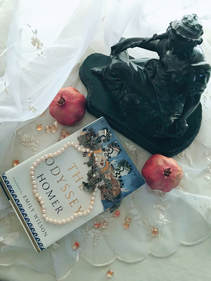
I AM reading Dr. Emily Wilson's English translation of the Odyssey. It's the first time a woman has translated Homer's work into English. The fanfare has just begun and rightly so. I'll probably do a podcast about her work, because I love it so much. I've read several translations and used them in researching my work for the Homeric Chronicles, but NONE of them has touched me like Dr. Wilson's.
For example, as everyone already points out, she begins with calling Odysseus a "complicated man." Brilliant, because Odysseus is complicated. He's not straight forward in anything he does. He's tender and loving with Penelope and Telemachus, but he's also a murderer and a man who "skirts" the boundaries of his marriage. He's vengeful, but with good reason. A trouble maker and a charmer. And stubborn. Let's not forget stubborn. Despite all this, we love to love Odysseus.
Her word choices stand out for me, more than any other translation. Reading the scene where Odysseus is deciding when to kill the slave women (and mind you it's not a moral dilemma of IF he should, but a matter of WHEN he will kill them...this is one of the ways he's complicated: his ability to premeditate massive slaughter) builds such powerful imagery. I can see a mother dog guarding her puppies, teeth bared and growling at strangers. It's scrappy, fierce, and dangerous.
For example, as everyone already points out, she begins with calling Odysseus a "complicated man." Brilliant, because Odysseus is complicated. He's not straight forward in anything he does. He's tender and loving with Penelope and Telemachus, but he's also a murderer and a man who "skirts" the boundaries of his marriage. He's vengeful, but with good reason. A trouble maker and a charmer. And stubborn. Let's not forget stubborn. Despite all this, we love to love Odysseus.
Her word choices stand out for me, more than any other translation. Reading the scene where Odysseus is deciding when to kill the slave women (and mind you it's not a moral dilemma of IF he should, but a matter of WHEN he will kill them...this is one of the ways he's complicated: his ability to premeditate massive slaughter) builds such powerful imagery. I can see a mother dog guarding her puppies, teeth bared and growling at strangers. It's scrappy, fierce, and dangerous.
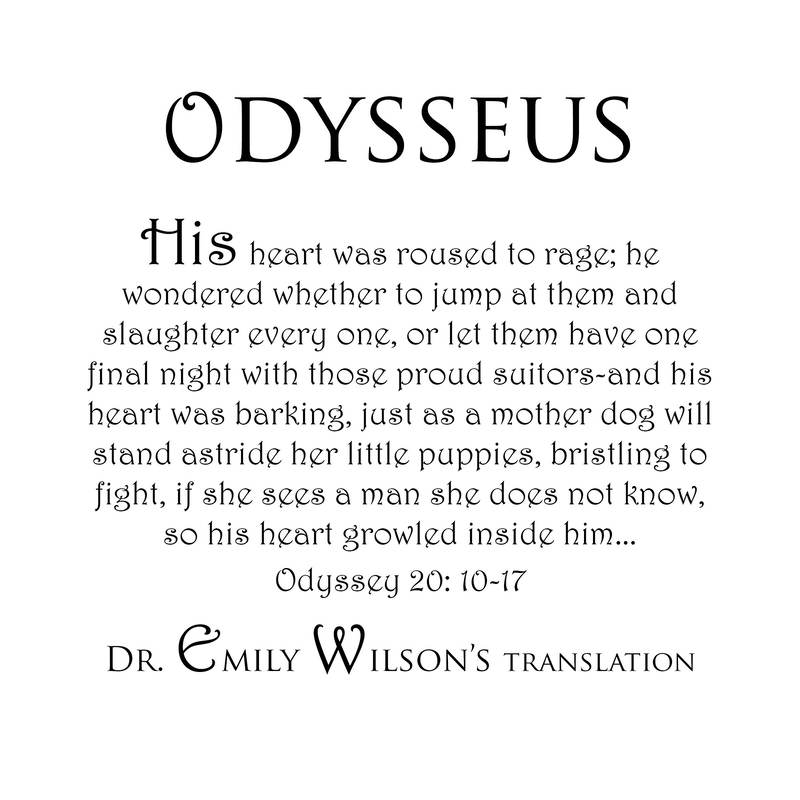
Dr. Wilson is equally descriptive with Penelope. I love the passage where Penelope has just been told that the suitors are plotting to kill her son, Telemachus. She's distraught because he left Ithaka without telling her and no one knows for sure where he is. So, she can't protect him. Her mind torments her like a trapped lion...What parent can't relate to that terrifying feeling?

She definitely spanked some magic out of Homer's Greek.
If you enjoy Greek mythology, you're going to love this new translation. I'm using it for all my podcasts on Greek Mythology Retold and for the continued research for the Homeric Chronicles.
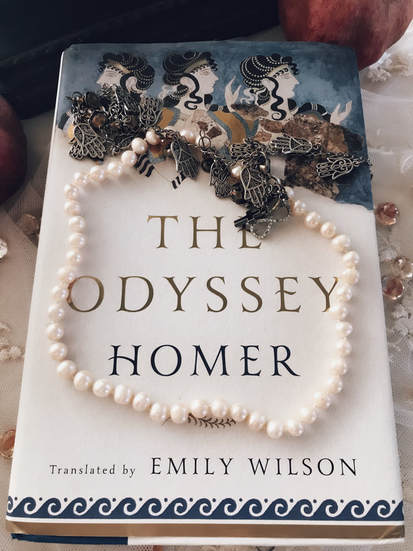

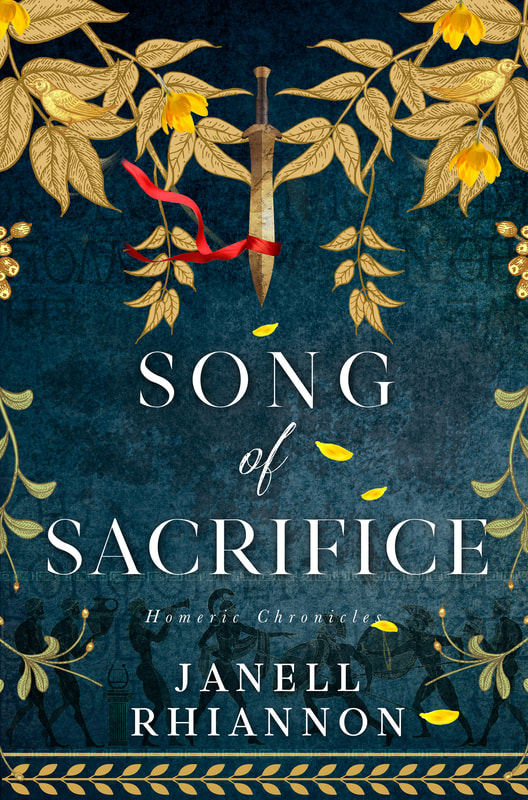
|
For more Greek myths and Trojan War, try the Homeric Chronicles.
Song of Sacrifice
Rise of Princes
|
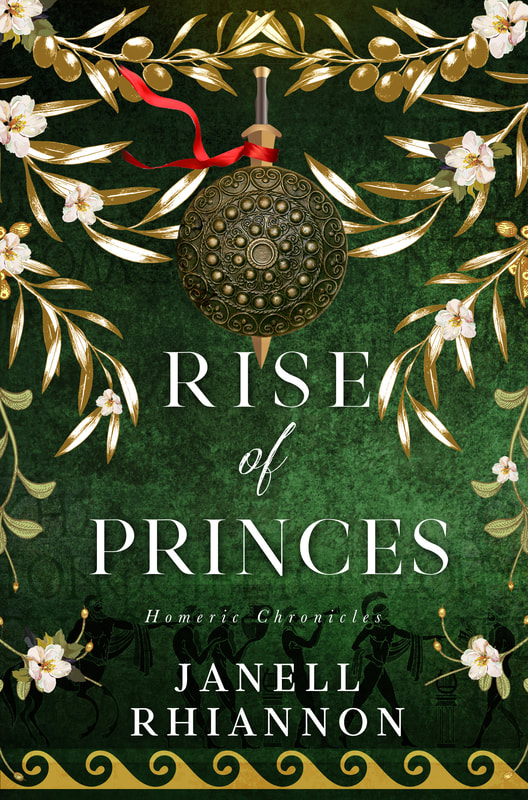
|
(Disclaimer: these are my show notes. I do go off script when I podcast, but here's the basic framework)
Hello fellow myth lovers! I’m so excited to share with you the Greek world of the Homeric Chronicles. If you watched the movie Troy and loved it, or felt like you wanted more...If you’re currently watching the BBC One Troy: Fall of a City (or waiting for it to hit your Netflix playlist), this podcast is for you. You’re a Myrmidon. Basically, if you love Greek mythology in any form you’ve come to the right place. Shall we get started?
When I first began toying with the idea it was...what if you could read about all the mythological stories as one seamless tale? I thought, what if George RR Martin was telling it? It would be EPIC! CRAZY HUGE! Can you imagine the cast of characters? It’d be a celebrity Who’s Who of the ancient myth-historic Greek world. And because I love these stories, I got to thinking...what if I wrote it? No way, I can’t do that. Then, I thought, you have a degree in history, why not try? And the Homeric Chronicles was born.
That left me with the million dollar question: Where to start? How to begin? After piles of research, 25 gray hairs carefully dyed dark brown, and a bazillion cups of coffee later, I realized exactly where I needed to start: with Homer. But not just some retelling that was meant to get you to the “great war” or to take you through the bizarre journeys of Odysseus back to Ithaka...It needed to be MORE. Much more! But, Homer’s work in the Iliad and Odyssey definitely provide the backbone. I wove many other stories that touched on the characters in Homer’s work into the structure of the spine. The major heroes and heroines of Homer’s tales are entwined with so many other characters I had to dig deep, b/c it’s chronological, I had to make some hard choices. The original myth-makers weren’t worried about telling stories that made chronological sense outside of the story they were reciting. But for the Homeric Chronicles to be what I envisioned that’s exactly what I had to do.
I wanted to include the regulars: Achilles, Paris, Hektor, Odysseus, Menelaus, Agamemnon, Helen, Hecuba, Cassandra, Andromache, Leda, Deidamia, Priam, Tyndareus, Peleus, Thetis, and Chiron just to name a few. And include characters like Palamedes, the poor guy who unfortunately pissed off Odysseus, Tantalus the first husband of Clytemnestra, Oenone Paris’s first wife, Peisidike the Methymnaan princess in love with Achilles, well, you get the picture. Now, I was tasked with putting the myths in chronological order, and keeping them all easy to connect with.
It wasn’t until I fell in love with GRRM’s SOIAF that I knew structuring a story of this epic scale was possible. I take you along several characters’ journeys through five major kingdoms. And after the movie Troy ruthlessly cut them out (and I wonder if David Benioff wishes now that he hadn’t), I put the pantheon of gods and goddesses back in there.
On to chronology: The first chronological hiccup involved Helen, Paris and Achilles. Let’s start with Paris, in particular: the Judgment of Paris. Most people familiar with the story assume that Paris gives the judgment of the fairest goddess to Aphrodite and leaves to Sparta not long after. But, it just doesn’t make sense that way, not in the context of the larger EPIC tale. Let me explain:
The golden apple contest that caused the Athena, Aphrodite and Hera to seek Paris as the judge occurred at the wedding feast of Peleus and Thetis. These are Achilles parents. So, Achilles, the greatest fighter of all the Greeks has NOT been born yet. He’s the star of the Iliad. So, the judgment of Paris takes place soon after the wedding feast, before Achilles is conceived and born. Why does this matter? Because, we have to wait at least 15 to 18 years for Achilles to grow up, get trained, and father a son, Neoptolemus, BEFORE Odysseus can discover him on Skyros, dressed like a girl and call our hero into action. This means two things: Paris has to be at least 15-18 years old to be considered MAN enough to judge the goddesses (he’s not an 8 yr old judging 3 of the most powerful females in the story); therefore, Paris is 15-18 years older than Achilles. Most movies and books depict Paris and Achilles about the same age, or as in Troy make Paris much younger than Achilles. It’s all wrong. Paris is definitely Achilles’ elder.
That raises the next logical question: When does Paris meet and woo Helen? Because that is the EVENT that brings the Argives, Achaeans, Danaans to Troy. Paris couldn’t have taken off with Helen any time soon following the judgment because that would mean Paris and Helen would’ve been in Troy for years before Menelaus even tried to get her back...B/C we’d be waiting for Achilles to get born and come of age. Even if you take the whole Paris and Helen get lost in Egypt into consideration that still leaves too many years in between the kidnapping and the attempted rescue. Remember, no matter what, Achilles has to be old enough to lead the Myrmidons and have fathered a child before he goes to Troy, as other prophecies depend on it.
Hello fellow myth lovers! I’m so excited to share with you the Greek world of the Homeric Chronicles. If you watched the movie Troy and loved it, or felt like you wanted more...If you’re currently watching the BBC One Troy: Fall of a City (or waiting for it to hit your Netflix playlist), this podcast is for you. You’re a Myrmidon. Basically, if you love Greek mythology in any form you’ve come to the right place. Shall we get started?
When I first began toying with the idea it was...what if you could read about all the mythological stories as one seamless tale? I thought, what if George RR Martin was telling it? It would be EPIC! CRAZY HUGE! Can you imagine the cast of characters? It’d be a celebrity Who’s Who of the ancient myth-historic Greek world. And because I love these stories, I got to thinking...what if I wrote it? No way, I can’t do that. Then, I thought, you have a degree in history, why not try? And the Homeric Chronicles was born.
That left me with the million dollar question: Where to start? How to begin? After piles of research, 25 gray hairs carefully dyed dark brown, and a bazillion cups of coffee later, I realized exactly where I needed to start: with Homer. But not just some retelling that was meant to get you to the “great war” or to take you through the bizarre journeys of Odysseus back to Ithaka...It needed to be MORE. Much more! But, Homer’s work in the Iliad and Odyssey definitely provide the backbone. I wove many other stories that touched on the characters in Homer’s work into the structure of the spine. The major heroes and heroines of Homer’s tales are entwined with so many other characters I had to dig deep, b/c it’s chronological, I had to make some hard choices. The original myth-makers weren’t worried about telling stories that made chronological sense outside of the story they were reciting. But for the Homeric Chronicles to be what I envisioned that’s exactly what I had to do.
I wanted to include the regulars: Achilles, Paris, Hektor, Odysseus, Menelaus, Agamemnon, Helen, Hecuba, Cassandra, Andromache, Leda, Deidamia, Priam, Tyndareus, Peleus, Thetis, and Chiron just to name a few. And include characters like Palamedes, the poor guy who unfortunately pissed off Odysseus, Tantalus the first husband of Clytemnestra, Oenone Paris’s first wife, Peisidike the Methymnaan princess in love with Achilles, well, you get the picture. Now, I was tasked with putting the myths in chronological order, and keeping them all easy to connect with.
It wasn’t until I fell in love with GRRM’s SOIAF that I knew structuring a story of this epic scale was possible. I take you along several characters’ journeys through five major kingdoms. And after the movie Troy ruthlessly cut them out (and I wonder if David Benioff wishes now that he hadn’t), I put the pantheon of gods and goddesses back in there.
On to chronology: The first chronological hiccup involved Helen, Paris and Achilles. Let’s start with Paris, in particular: the Judgment of Paris. Most people familiar with the story assume that Paris gives the judgment of the fairest goddess to Aphrodite and leaves to Sparta not long after. But, it just doesn’t make sense that way, not in the context of the larger EPIC tale. Let me explain:
The golden apple contest that caused the Athena, Aphrodite and Hera to seek Paris as the judge occurred at the wedding feast of Peleus and Thetis. These are Achilles parents. So, Achilles, the greatest fighter of all the Greeks has NOT been born yet. He’s the star of the Iliad. So, the judgment of Paris takes place soon after the wedding feast, before Achilles is conceived and born. Why does this matter? Because, we have to wait at least 15 to 18 years for Achilles to grow up, get trained, and father a son, Neoptolemus, BEFORE Odysseus can discover him on Skyros, dressed like a girl and call our hero into action. This means two things: Paris has to be at least 15-18 years old to be considered MAN enough to judge the goddesses (he’s not an 8 yr old judging 3 of the most powerful females in the story); therefore, Paris is 15-18 years older than Achilles. Most movies and books depict Paris and Achilles about the same age, or as in Troy make Paris much younger than Achilles. It’s all wrong. Paris is definitely Achilles’ elder.
That raises the next logical question: When does Paris meet and woo Helen? Because that is the EVENT that brings the Argives, Achaeans, Danaans to Troy. Paris couldn’t have taken off with Helen any time soon following the judgment because that would mean Paris and Helen would’ve been in Troy for years before Menelaus even tried to get her back...B/C we’d be waiting for Achilles to get born and come of age. Even if you take the whole Paris and Helen get lost in Egypt into consideration that still leaves too many years in between the kidnapping and the attempted rescue. Remember, no matter what, Achilles has to be old enough to lead the Myrmidons and have fathered a child before he goes to Troy, as other prophecies depend on it.
My research took me to Apollodorus (a 2nd century AD compilation of ancient texts) which states in 3.13.8 that Achilles was 9 when he was taken to Skyros, because Odysseus was looking for him due to a prophecy by Agamemnon’s seer, Kalchus. There is some consensus that Achilles left Skyros at about 15. But let’s break this down chronologically and logically.
1. If Odysseus is looking for Achilles when Achilles is 9 and that’s why Thetis hid him as a girl, then he has to be hiding there for years before he’s old enough to get the princess Deidamia pregnant. So, for all these years, what are the Greeks under assembled under Agamemnon’s banner doing in Aulis? Twiddling their thumbs? Sewing sails? Getting sunburns? If the consensus is correct (and we have to make choices to be consistent) at least 6 years (give or take) have to pass until Odysseus finds Achilles.
2. I recall reading that there were TWO calls to war that met at Aulis...the first one which assembled the Greek tribes went to Aulis was a bust b/c they needed Achilles, so everyone went home and waited...then returned...years later? after Achilles was found? This doesn’t make any sense...it would’ve been a monumental feat getting that many ships and men from all across the Greek world assembled just once, but twice? And in all his searching, Odysseus never makes it back to Ithaka to sneak a little love time in with Penelope? I don’t buy it.
3. What makes sense in the human and mytho-historic terms is that Achilles is 9 when he goes to Skyros with Thetis fully aware about Achilles’ dual fate, and that some day he’d have a huge decision to make. When the call to Aulis came, 6 or so years later, that’s when Odysseus and Ajax find him. It gives time for him to grow up, father a son. I do give Achilles a few more years, rounding out his age at 18. Why? Because I used the historic figure, Alexander the Great, as a model. Alexander distinguished himself at Chaeronea at 18, so makes sense that a young man at 18 could indeed be seen to lead an army of warriors (Myrmidons).
Well, Myrmidons, times up for today. Up next time let’s take a deeper look into Helen’s age and how placing her story in chronological sequence was challenging, but not impossible.
For now--
What do you think about Paris being 18 years older than Achilles? that Helen couldn’t have been born at the time of the judgment?
How do you think a comprehensive timeline will change up the Greek myths as you know them?
1. If Odysseus is looking for Achilles when Achilles is 9 and that’s why Thetis hid him as a girl, then he has to be hiding there for years before he’s old enough to get the princess Deidamia pregnant. So, for all these years, what are the Greeks under assembled under Agamemnon’s banner doing in Aulis? Twiddling their thumbs? Sewing sails? Getting sunburns? If the consensus is correct (and we have to make choices to be consistent) at least 6 years (give or take) have to pass until Odysseus finds Achilles.
2. I recall reading that there were TWO calls to war that met at Aulis...the first one which assembled the Greek tribes went to Aulis was a bust b/c they needed Achilles, so everyone went home and waited...then returned...years later? after Achilles was found? This doesn’t make any sense...it would’ve been a monumental feat getting that many ships and men from all across the Greek world assembled just once, but twice? And in all his searching, Odysseus never makes it back to Ithaka to sneak a little love time in with Penelope? I don’t buy it.
3. What makes sense in the human and mytho-historic terms is that Achilles is 9 when he goes to Skyros with Thetis fully aware about Achilles’ dual fate, and that some day he’d have a huge decision to make. When the call to Aulis came, 6 or so years later, that’s when Odysseus and Ajax find him. It gives time for him to grow up, father a son. I do give Achilles a few more years, rounding out his age at 18. Why? Because I used the historic figure, Alexander the Great, as a model. Alexander distinguished himself at Chaeronea at 18, so makes sense that a young man at 18 could indeed be seen to lead an army of warriors (Myrmidons).
Well, Myrmidons, times up for today. Up next time let’s take a deeper look into Helen’s age and how placing her story in chronological sequence was challenging, but not impossible.
For now--
What do you think about Paris being 18 years older than Achilles? that Helen couldn’t have been born at the time of the judgment?
How do you think a comprehensive timeline will change up the Greek myths as you know them?
You can find out by reading the Homeric Chronicles
Song of Sacrifice and Rise of Princes
Love to hear your thoughts, answer questions, and connect with my fellow Greek mythology lovers.
Come on tweet me!
Join my mailing list for updates and Greeky things!
Until next time, let’s take the advice given to Menelaus in the Cypria: “know that the gods made wine the best thing for mortal man to scatter cares.” Drink your wine and be merry Myrmidons.
Song of Sacrifice and Rise of Princes
Love to hear your thoughts, answer questions, and connect with my fellow Greek mythology lovers.
Come on tweet me!
Join my mailing list for updates and Greeky things!
Until next time, let’s take the advice given to Menelaus in the Cypria: “know that the gods made wine the best thing for mortal man to scatter cares.” Drink your wine and be merry Myrmidons.
Start the journey...
|
|
I’ve been trying to write the Homeric Chronicles for years. It started as a short story about Odysseus and Penelope. That morphed into this “brilliant” idea (rolls eyes) of 4 novellas focused on the 4 major heroes: Achilles, Hektor, Paris, and Odysseus. In all this uncertainty, I was only certain that I had a story in there (somewhere) to tell that was different from anything out there. I loved the Iliad and Odyssey. As I wrote, I realized the stories overlapped (like puppies in a basket) and wouldn’t progress the way I wanted them to. That’s when it dawned on me that although the Iliad and Odyssey are easily placed in chronological order, the other myths that bleed into the larger framework do not. Crap. Mind. Blown. The story soon took on a life of its own, oozing all over my desk with sticky notes, scribblings on the backs of envelopes, printed articles, and a pin board. I labored like Herakles to construct a linear sequence that wove Homer’s tales together and THAT’S what pulled in dozens of characters I had no idea I’d be writing about. Then, something unexpected happened. I found myself writing more and more about the women. Giving them voice and filling out their storylines. When I was in the middle of working on book three, Rage of Queens, it struck me (TO MY HORROR, I might add)—I was doing it wrong. (The good, the bad, and the ugly of self-publishing).
Feeling like a complete idiot, I was confused how to proceed. I took a huge step back to reflect. Literally, stopped writing. I needed to sort through everything about indie publishing: Was I even a writer? Was I even a storyteller? Should I walk away now? Then, I did what I usually do when I don’t know what to do: clean or renovate my house. (Can anyone else relate to this?) As I stared at my bare concrete bedroom floors, I knew it was time to tile. Bent over the floor, back aching, knees on fire...NOTHING! and I mean nothing happened. No epiphany. No light bulb moment. #F-word again.
By accident, I stumbled onto Alesandra Torre’s marketing class and Mark Coker’s Smashwords podcast. I found the encouragement to NOT give up and that indie authorship is fluid and flexible. I began a podcast (Greek Mythology Retold) which gave me a platform to talk about my research and character development. This invigorated me. (As of today, I have almost 8000 downloads!) Anyway, I dove into the second edition of my first book, Song of Princes, in earnest. Although I’d deleted over 6000 words, I’d added 20,000 more in what ended up as 14 additional chapters and several subplots. The structure of SOP was still there, but it was more than a second edition. By this time, I knew the cover didn’t match an historical fantasy. It was time for some HUGE changes.
Regina Wamba created a new cover that captures everything about the Homeric Chronicles. The title became: Song of Sacrifice, because so many characters had sacrificed so many things: love, time, and relationships to survive.
I’m hard at work aligning Rise of Princes with its new cover design, too. Thank you for reading this whole thing, if you got this far. Song of Sacrifice is on preorder and as soon as I can get Rise of Princes out of KDP select (big mistake! very big mistake!), I’ll upload it everywhere book are sold.
Click over to listen to a podcast. If you love Greek Mythology, or my series, you might enjoy one or two of them. Oh Hades, listen to them all!
Regina Wamba created a new cover that captures everything about the Homeric Chronicles. The title became: Song of Sacrifice, because so many characters had sacrificed so many things: love, time, and relationships to survive.
I’m hard at work aligning Rise of Princes with its new cover design, too. Thank you for reading this whole thing, if you got this far. Song of Sacrifice is on preorder and as soon as I can get Rise of Princes out of KDP select (big mistake! very big mistake!), I’ll upload it everywhere book are sold.
Click over to listen to a podcast. If you love Greek Mythology, or my series, you might enjoy one or two of them. Oh Hades, listen to them all!
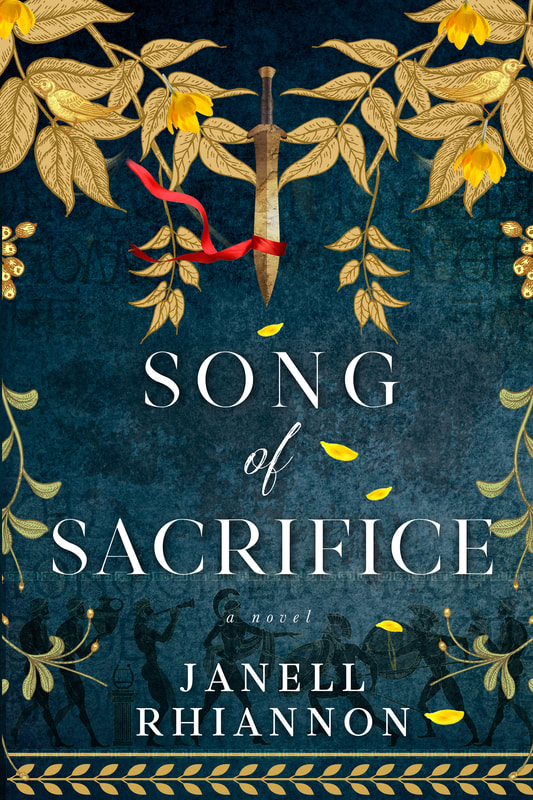
|
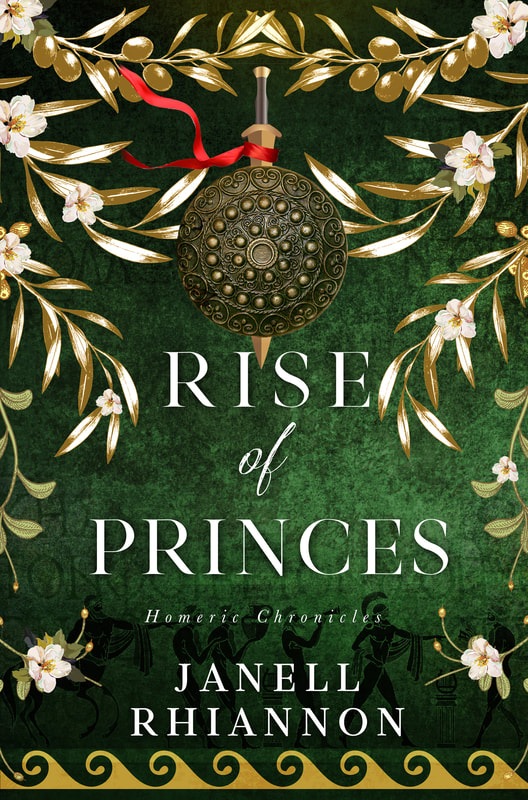
|

Today, I have a fun surprise that I’d like to share with you. I’ve teamed up with more than 50 fantastic Epic Fantasy authors to give away a huge collection of novels to 2 lucky winners, PLUS a Kindle Fire to the Grand Prize winner!
You can win my novel SONG OF PRINCES, plus books like Mark of Destiny and Descension .
Enter the giveaway by clicking here: bit.ly/epic-fantasy
You can win my novel SONG OF PRINCES, plus books like Mark of Destiny and Descension .
Enter the giveaway by clicking here: bit.ly/epic-fantasy
Author
Janell Rhiannon
"Though she be but little, she is fierce."
-Shakespeare
Archives
April 2022
June 2020
May 2020
December 2018
November 2018
October 2018
March 2017
February 2017
January 2017
October 2016
September 2016
July 2016
June 2016
December 2015
July 2015
June 2015
May 2015
September 2014
August 2014
July 2014
June 2014
July 2013
Categories
All
Achilles
Adult
A Jacob Sweeney
Amanda Hocking
Ancient Greece
Ancient Rome
Anna Snow
Apryl Baker
Audrey Grey
Barry Duffield
B.C. Morin
Beach Reads
Benjaminoftomes
Bethany Adams
Big Ten
Big Ten Interview
Blog Tour
Book Cover Model
Breast
Breastfeeding
Breasts
Bubblegum Blonde
Cameo Renae
Chicago Romance
Christian Fiction
Crixus
Dice Game
Dystopian
Elves
Emily Wilson
Erotica
Fairies
Fantasy
Fiction
Gargoyles
Grandmother
Grandmothers
Greek Heroes
Greek Heroines
Greek Mythology
Greek Mythology Retold
Greek Pottery
Greek Warrior
Guardian Angel
Happy Father's Day
Hector
Hecuba
Heir Of Darkness
Hektor
Helen Of Sparta
Helen Of Troy
Historical Romance
Homeric Chronicles
Iliad
Indie Publishing
Invisible Wings
Janell Rhiannon
Kendall Grey
Kiss
Kt Webb
Leda
LGBTQ
Livingstone Saga
Love
Lugo
Malibu Photo Shoot
Medieval
Mythology
Nerdgirlofficial
New Adult
Non-binary
Odysseus
Odyssey
Paranormal
Paris
Parnormal Romance
Penelope
Penned Con
Podcast
Poetry
Rachel Higginson
Randi Cooley Wilson
Rise Of Princes
Sci-fi
Sexy
Sexy Feet
Shadow Fall
Soldiers
Song Of Princes
Song Of Sacrifice
Song Of War
Spain
Spartacus
Spartacus Starz
Stepanie Thornton
The Coven Series
The Oath
The Promise
Thomas David
Tracy James Jones
Transgender
Trojan War
Trojan War Fiction
Trojan War Timeline
Vampires
Writing
YA
 RSS Feed