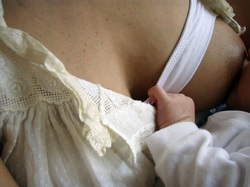
 In our modern American society, many Americans have a strange phobia about women baring a breast (and maybe a peak of a nipple) when it comes to breastfeeding. I personally find this a strange phenomenon. Breast feeding is the most NATURAL activity that a women can do with her boobs (okay, maybe it's also natural she hugs them when jumping up and down, or massages them after whipping her bra off...you get the picture). What are people afraid of when it comes to a mother breastfeeding her baby? Getting turned on? Maybe breasts, heavy with milk, are a magical food source luring unsuspecting citizens into lascivious behavior, infidelity and acts of random rudeness. And just maybe, people should get a frickin' grip on their overactive imaginations and prudish attitudes. Watch this undercover video of Americans supporting and freaking out about a woman "breastfeeding" a baby... Since human beings began populating the earth, women have literally been pulling a bare breast out and nursing their young. And, sorry America, it's what breasts were designed to do. In fact, the earliest carved (per-historic) statue of a human is the Venus of Willendorf figure, a woman, dating from 30,000 and 25,000 BCE. She has pronounced breasts and hips, emphasizing her femininity, hence her power through the ability to give and maintain life. What does all this have to do with mythology, Homer and the Homeric Chronicles? According to the 2015 article entitled, "Breastfeeding in the Course of History," in the Journal of Pediatrics & Neonatal Care [JPNC], "In Ancient Mesopotamia and Ancient Greece, breastfeeding was of high value and one can find numerous references in mythology." And I agree with that based on what I've read in the Ilaid and Odyssey as well as other mythological and historical sources. In the ancient world, breast milk was considered sacred and nursing children was considered an essential and important part of a child's upbringing. The JPNC article delves into numerous examples of goddesses and women breastfeeding their babies. It's worth a read. The authors go on to talk about how only in the 20th century, when formula companies became en vogue, (and of course interested in making money) did the tide of public opinion against breastfeeding and mothers began to be and feel shamed by a natural and simple act. Back to Homer and my point. One of my favorite scenes in the Iliad is when Hektor realizes he must face Achilles, and in doing so, most likely face his death. His father, King Priam, begs him not to go before the wall and fight the crazy Greek warrior. He laments that Zeus has cursed him because he's lost so many sons already, and now is poised to lose his eldest son and heir as well. Hektor's mother, Queen Hecuba joins her husband's lament and begs in a much more intimate way. In Book 21, she opens up her gown and pulls out her bare breast, weeping with the heart-ache she knows is coming, and begs Hektor to honor what she gave him from the beginning: life. By her bare breasts she beseeches her warrior son to give up fighting because that bond between mother and child is sacred, and worthy of honor. And it was her breast that symbolized that honor. Throughout the Homeric Chronicles, Book One, Song of Princes I have used the motif of the breast and breastfeeding to symbolize the sacred connection between mother and child. It is an intimate and natural act. And when Hecuba is unable to nurse her second son, Paris, it breaks her heart. And that maternal pain is juxtaposed to the joy she felt with her first born, Hektor, and why she refuses a nursemaid for her subsequent children. Don't get me wrong, there is plenty of adult level sexy bits in this series (steamy, I think @Benjaminoftomes said) but I have purposely left the breast on a pedestal. If you enjoyed this post, give it a LIKE or a TWEET :) And by all means, SHARE :) If you'd like a heads up on future Big Ten Interviews or giveaways, join my email list. The only spam I like is with my eggs.
|
Author
|
 RSS Feed